
Root
bio
life, living things
Greek bios named a life — its length and its manner — as opposed to zoe, the bare fact of being alive. English made it the prefix of both the life sciences and the life story: biology and biography are siblings built at the same time from the same two Greek pieces.
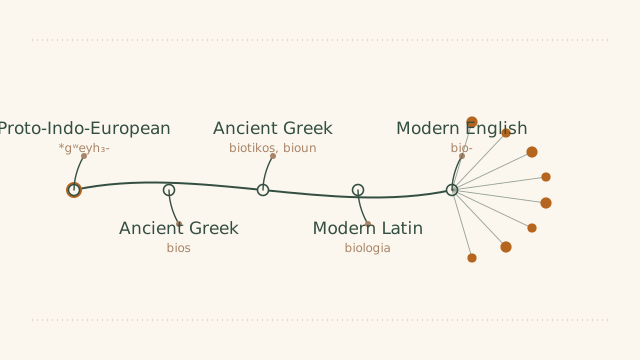
Etymology tree
Open any stage for the note attached to it.
-
01 Proto-Indo-European *gʷeyh₃-
to live
The base behind Greek bios and zoe, and also behind Latin vivere, so biology and survive are distant cousins through different routes.
-
02 Ancient Greek bios
life, way of life, lifespan
Greek had two words for life: bios, the span and manner of a life, and zoe, the bare fact of being alive. Biology took bios.
-
03 Ancient Greek biotikos, bioun
of life, to live
biotikos gives English biotic and, through medieval Latin, the word biotic in antibiotics.
-
04 Modern Latin biologia
the study of life
Coined around 1800 by German and French naturalists from Greek bios plus logos, at the same moment as geology and zoology.
-
05 Modern English bio-
life; living; of a life
Now splits into three senses: scientific (biochemistry), medical (biopsy, antibiotic) and biographical (biography, biopic).
8 words · branching from the last stage
Stage by stage
| # | Stage | Form | What it meant |
|---|---|---|---|
| 1 | Proto-Indo-European | *gʷeyh₃- | to live |
| 2 | Ancient Greek | bios | life, way of life, lifespan |
| 3 | Ancient Greek | biotikos, bioun | of life, to live |
| 4 | Modern Latin | biologia | the study of life |
| 5 | Modern English | bio- | life; living; of a life |
Two Greek words for life
Greek kept bios and zoe apart with some care. Zoe was life as a condition — the opposite of death — and is the word used in zoology and in the name Zoe itself. Bios was a life as a particular thing: a span, a career, a way of living, the thing you describe when you tell someone's story.
That distinction is why the two most familiar English bio-words point in different directions. Biology, with logos, is the study of living things in general, a science. Biography, with graphein, is the writing of one life, a genre. Both were coined within a few decades of 1800, and both were built by naturalists and men of letters who knew exactly which Greek word they were using.
The prefix turns technical
Chemistry, medicine and ecology then took the prefix and made it ordinary. Biochemistry (1880s) studies the chemistry of living matter; biosphere (1875, coined by Eduard Suess) treats the living layer of the planet as a single object; biodiversity appeared in the 1980s when the conservation movement needed a word for what it was trying to protect.
Medicine built a parallel set with a slightly darker tone, since many of its words describe what goes wrong: biopsy (a look at living tissue), biotoxin, biocide, and the various -biotics that either kill or support bacteria. All still carry the Greek word for life, even when the life in question is being removed.
- biology — 1802 by Lamarck and Treviranus independently
- biography — 1660s, at first for a written life in the general sense
- biochemistry — 1880s, the chemistry of living matter
- biosphere — 1875, Suess's term for the living layer of the Earth
- biodiversity — 1980s, coined for the conservation movement
- biopic — 1950s, a Hollywood clipping of biographical picture
False friends on the same stem
The prefix is so attractive that it has been attached to words where it means almost nothing — bioterrorism is terrorism, biometrics is measurement — but in each case the bio- element is doing real work, since the target or the object is a living body.
Two traps are worth naming. Symbiosis is "living together" and is used in business writing as a loose synonym for cooperation, though biologists use it strictly. And antibiotic is often misread as meaning "anti-illness"; the -biotic element comes from biotikos, "of life", and the word was coined in 1941 for substances that kill bacteria.
Kindred family
English words grown from this root, with the part of speech and a plain gloss.
| Word | Part of speech | Gloss |
|---|---|---|
| biology | noun | the study of living things |
| biography | noun | a written life |
| antibiotic | noun | a substance working against life (i.e. against bacteria) |
| biopsy | noun | a look at living tissue |
| biodiversity | noun | the variety of life |
| biosphere | noun | the sphere of life |
| symbiosis | noun | living together |
| biodegradable | adjective | able to be broken down by living things |