
Root
geo
the earth, land
Greek ge named the earth under your feet and the planet you stand on, and the same word sat inside geometry long before anyone wrote geography. The prefix now covers both old sciences and new technologies, which is unusual for a root this ancient.
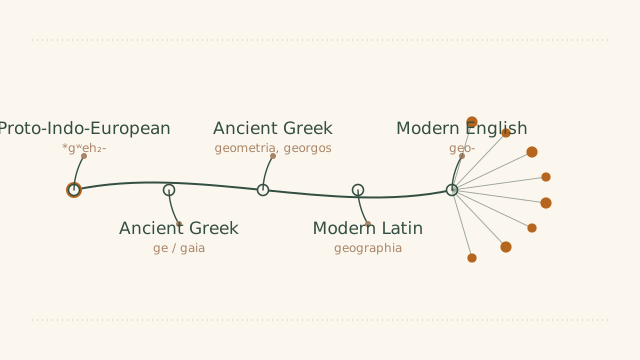
Etymology tree
Open any stage for the note attached to it.
-
01 Proto-Indo-European *gʷeh₂-
the earth, ground
Related to the base behind Latin humus (soil) and possibly to the name of the goddess Gaia.
-
02 Ancient Greek ge / gaia
earth, land, country
Used both for the planet and for a particular territory, which is why geography can mean the study of the whole world or of one region.
-
03 Ancient Greek geometria, georgos
land-measuring; earth-worker
Geometry began as land surveying for agriculture and taxation — the practical origin of a famously abstract subject.
-
04 Modern Latin geographia
description of the earth
Eratosthenes used the term in the third century BCE; it entered English through Latin in the 1500s.
-
05 Modern English geo-
earth, of the earth
Now the standard prefix for earth sciences and anything positioned relative to the globe: geology, geothermal, geolocation.
8 words · branching from the last stage
Stage by stage
| # | Stage | Form | What it meant |
|---|---|---|---|
| 1 | Proto-Indo-European | *gʷeh₂- | the earth, ground |
| 2 | Ancient Greek | ge / gaia | earth, land, country |
| 3 | Ancient Greek | geometria, georgos | land-measuring; earth-worker |
| 4 | Modern Latin | geographia | description of the earth |
| 5 | Modern English | geo- | earth, of the earth |
Farming before mathematics
The oldest use of this root in English is in geometry, and the word means exactly what it says: land measurement. Egyptian and Babylonian surveyors needed to re-establish field boundaries after the Nile flood and to assess tax on plots, and the procedures they developed for triangles and areas became the basis of Greek geometry.
So the most abstract subject in the school curriculum starts as a tax office. When Euclid wrote the Elements in about 300 BCE, the surveying sense had already been left behind, but the name never changed — geometry is still, etymologically, the measuring of the earth.
Describing the whole surface
Geography is a later formation, and its history shows how the word shifted from a list to a science. Eratosthenes used geographia for his map of the known world in the third century BCE, and for centuries afterwards geography meant the description of places — Ptolemy's Geography is largely a gazetteer of coordinates.
The explanatory sense only dominates from the nineteenth century, when Alexander von Humboldt and Carl Ritter argued that the subject should study processes and relationships rather than collect facts. Geopolitics followed in 1899, coined by Rudolf Kjellén, and it has been a contested word ever since.
- geometry — land measurement, then the mathematics of shape
- geography — Ptolemy's word for a description of the known world
- geology — coined in the 1730s for the study of the earth's structure
- geocentric — the earth at the centre of the system, the standard view until 1543
- geopolitics — 1899, the study of power as determined by geography
- geothermal — the earth's own heat, exploited for power from the 1900s
The prefix goes digital
In the last thirty years geo- has become one of the most commercial prefixes in English, because position became a data field. Geolocation, geotagging, geofencing, geospatial and geo-targeting were all coined or popularised after 1995, and they are now ordinary in advertising, logistics and app development.
The older scientific sense is not displaced, and the two live side by side without much confusion. A geothermal plant is geology applied; a geo-targeted advert is geography applied; and both are, etymologically, about the earth under your feet.
Kindred family
English words grown from this root, with the part of speech and a plain gloss.
| Word | Part of speech | Gloss |
|---|---|---|
| geography | noun | a description of the earth |
| geology | noun | the study of the earth's structure |
| geometry | noun | land measurement; the mathematics of shape |
| geothermal | adjective | relating to the earth's heat |
| geopolitics | noun | politics determined by geography |
| geocentric | adjective | taking the earth as the centre |
| apogee | noun | the point farthest from the earth |
| geode | noun | a stone that looks earthlike; a hollow rock lined with crystals |