
Root
log / logue
word, speech, reason
Greek logos meant a word, an account, and the rational order behind things — all at once. English took it as a suffix and built the entire architecture of academic disciplines on top of it, and it also took it as a noun, in logic and dialogue, where the older senses are still visible.
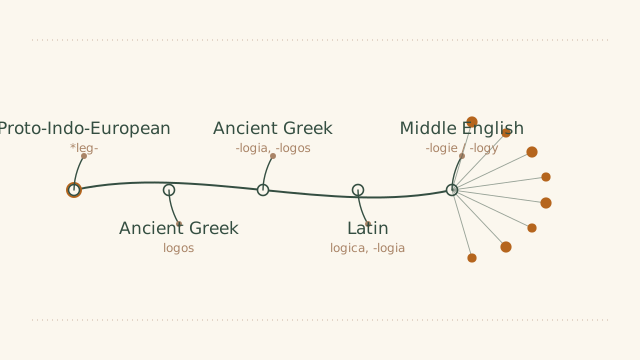
Etymology tree
Open any stage for the note attached to it.
-
01 Proto-Indo-European *leg-
to gather, to pick out words
The sense moved from gathering things to gathering words, and then to the words themselves.
-
02 Ancient Greek logos
word, speech, account, reason
A single noun covering an unusual range: a spoken word, an account you give of something, and the rational order of the world.
-
03 Ancient Greek -logia, -logos
the study of; one who speaks of
Greek used these endings to name fields of study long before English borrowed them. They were productive in Greek exactly as -logy is in English now.
-
04 Latin logica, -logia
logic; the study of
Medieval Latin passed the Greek endings into the European vernaculars as a ready-made suffix for scholarship.
-
05 Middle English -logie / -logy
study of
From the fourteenth century the suffix spread faster than any individual word in it: theology, astrology, geology, biology, sociology.
8 words · branching from the last stage
Stage by stage
| # | Stage | Form | What it meant |
|---|---|---|---|
| 1 | Proto-Indo-European | *leg- | to gather, to pick out words |
| 2 | Ancient Greek | logos | word, speech, account, reason |
| 3 | Ancient Greek | -logia, -logos | the study of; one who speaks of |
| 4 | Latin | logica, -logia | logic; the study of |
| 5 | Middle English | -logie / -logy | study of |
One noun, three jobs
Logos did three jobs in Greek. It was the ordinary word for a spoken utterance; it was the word for an account or reckoning, as in giving logos of money spent; and in philosophy it became the rational principle that holds the world together. The Gospel of John opens with this third sense, which is why logos is translated both as "word" and as "reason" in different traditions.
English inherited the middle sense most completely. A catalogue is an account of items one by one, an analogy is an account set beside another, and a dialogue is an exchange of accounts. That is why these words are all slightly more formal than their plain English equivalents — list, comparison, conversation.
The suffix that built the university
Greek used -logia to name a body of knowledge, and Latin passed the ending to Europe intact. English has since attached it to stems from both languages, which is why the family contains Greek bases (biology, psychology, astrology) and Latin ones (sociology, terminology) side by side, and occasionally a hybrid that a purist would object to.
The pattern extends past -logy. -logue gives dialogue, monologue, prologue, epilogue and travelogue; -logist gives the practitioner; -logical gives the adjective and brings a pronunciation trap with it, since logical keeps a hard g while geology has a soft one.
- -logy: biology, geology, ecology, theology, technology, methodology
- -logue: dialogue, monologue, prologue, epilogue, travelogue
- -logist: biologist, geologist, technologist, etymologist
- -logical: logical, biological, geological — note the hard g in logical
- -log: the shortened form in American university slang for a lecture course
- technology — Greek techne (craft) + logos, "an account of a craft", first used in the seventeenth century
Traps in the -logue family
Two words in this family are false friends for learners. Apology is a defence, not a regret: the Greek apologia was a speech in one's own defence, and the modern sense of apologising only appears in the sixteenth century. Eulogy is literally "good words", which is why it is used for a funeral speech and not, as learners sometimes assume, for any long speech.
A third trap is pronunciation rather than meaning. English speakers say a hard g in logic, logistical, monologue and analogue, but a soft g in biology, geology and apology. There is no rule to derive this from the spelling; the pronunciation follows the age of the borrowing, with older French-shaped words taking the soft g.
Kindred family
English words grown from this root, with the part of speech and a plain gloss.
| Word | Part of speech | Gloss |
|---|---|---|
| logic | noun | reasoned argument; the study of valid inference |
| dialogue | noun | speech between two parties |
| monologue | noun | speech by one person alone |
| catalogue | noun | a list that accounts for things one by one |
| analogy | noun | a proportion or account set beside another |
| apology | noun | a speech in one's own defence |
| eulogy | noun | speech of good words about someone |
| geology | noun | the account of the earth |