
Root
therm
heat, warmth
Greek thermos meant hot and therme meant heat, and English took both to build the vocabulary of temperature: the instrument (thermometer), the property (thermal), the control (thermostat) and the science (thermodynamics). It is one of the few roots whose products sit in every household.
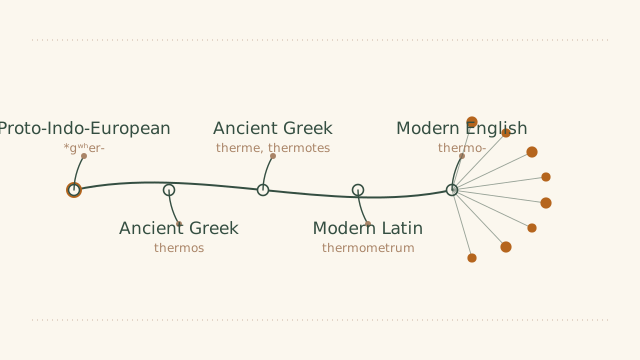
Etymology tree
Open any stage for the note attached to it.
-
01 Proto-Indo-European *gʷʰer-
warm, hot
The same base gives Latin fornus (oven) and English warm and burn, so thermal and warm are extremely distant relatives.
-
02 Ancient Greek thermos
hot, warm
An adjective, not a noun: Greek therme was the noun for heat, and thermos was the adjective applied to water, baths and fevers.
-
03 Ancient Greek therme, thermotes
heat; hotness
Aristotle treated heat as one of the primary qualities of bodies, which put the word at the centre of physics as well as medicine.
-
04 Modern Latin thermometrum
heat-measure
Coined in the 1620s, within a few years of barometrum; the instrument and the name arrived together.
-
05 Modern English thermo-
heat; temperature
Now standard in physics, engineering and biology: thermodynamics, thermal, hypothermia, endothermic, geothermal.
8 words · branching from the last stage
Stage by stage
| # | Stage | Form | What it meant |
|---|---|---|---|
| 1 | Proto-Indo-European | *gʷʰer- | warm, hot |
| 2 | Ancient Greek | thermos | hot, warm |
| 3 | Ancient Greek | therme, thermotes | heat; hotness |
| 4 | Modern Latin | thermometrum | heat-measure |
| 5 | Modern English | thermo- | heat; temperature |
Heat as a quality before a quantity
For most of its history the word was qualitative. Aristotle listed hot and cold among the primary qualities of bodies, alongside wet and dry, and in that scheme heat was a property things had rather than something that could be measured. The Greek adjective thermos and the noun therme belong to that world.
The change came with the instruments. Once the thermometrum was built in the 1620s and calibrated in the eighteenth century, heat became a quantity, and the vocabulary had to follow. Thermal, thermometer, thermostat and thermodynamics all date from the period between 1620 and 1850, when the physics of heat was being rebuilt from scratch.
The instrument family
This is one of the roots where the words and the devices can be learned together, which makes it a good teaching example. A thermometer measures temperature; a thermostat holds it steady by switching something on and off; a thermocouple converts a temperature difference into a voltage; a thermos keeps heat from escaping.
Two of those names are interesting for different reasons. Thermostat is a nineteenth-century coinage built on statos, "standing", so it means something that makes heat stand still. Thermos is a trade name — the German firm Thermos GmbH — that became generic in English and did so against the company's wishes, a fate shared by aspirin and escalator.
- thermometer — 1620s, heat plus measure
- thermostat — 1830s, heat plus standing, a device for holding temperature
- thermocouple — 1820s, a pair of metals that turns heat into current
- thermos — 1904 German trade name, generic in English by the 1920s
- thermodynamics — 1849, coined by William Thomson (Lord Kelvin)
- isotherm — 1840s, a line on a map joining points of equal temperature
The medical and the modern
Medicine uses the root for conditions of body temperature: hypothermia, hyperthermia, and also thermoregulation, the process by which a body holds its own temperature near 37 degrees. The old Hippocratic idea that heat is a bodily quality survives in this vocabulary even though the physics behind it is completely different.
Engineering uses it for anything that has to be managed: thermal insulation, thermal expansion, thermal imaging, geothermal and thermoelectric power. The last of these is a reminder that the root travels well — a geothermal plant is Greek geo plus Greek therme, two words that spent two thousand years apart and were put back together in Iceland in the 1920s.
Kindred family
English words grown from this root, with the part of speech and a plain gloss.
| Word | Part of speech | Gloss |
|---|---|---|
| thermometer | noun | a heat-measurer |
| thermal | adjective | relating to heat |
| thermostat | noun | a device that holds heat steady |
| hypothermia | noun | below-normal body heat |
| endothermic | adjective | absorbing heat; heated from within |
| exothermic | adjective | releasing heat |
| thermodynamics | noun | the study of heat and work |
| isotherm | noun | a line of equal temperature |