
Root
graph / gram
to write, to draw
Greek graphein, "to write or scratch", is the scientific twin of the Latin scrib- root, and it is far more productive in modern coinage. The three endings -graph, -graphy and -gram divide every word in the family by role: instrument, process, product.
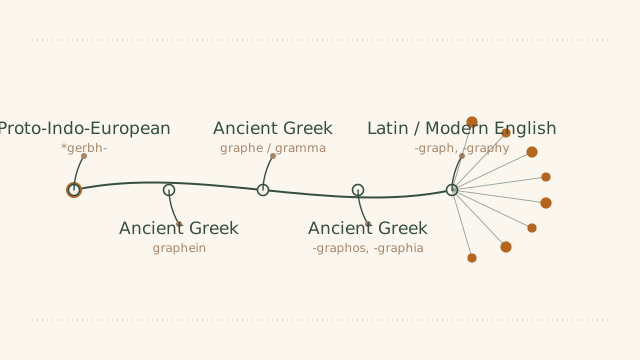
Etymology tree
Open any stage for the note attached to it.
-
01 Proto-Indo-European *gerbh-
to scratch, to carve
The same physical sense as the Latin scrib- root. Both languages started from the idea of cutting a mark into a surface.
-
02 Ancient Greek graphein
to write, to draw, to scratch
Greek used one verb for drawing a picture and writing a letter, and never needed to separate them.
-
03 Ancient Greek graphe / gramma
a writing, a letter; something written
gramma is the noun behind grammar, and the -gram in telegram and diagram.
-
04 Ancient Greek -graphos, -graphia
one who writes; a writing or describing
Used in Greek for a scribe, then extended to any instrument or process that records something.
-
05 Latin / Modern English -graph, -graphy
recording instrument; the process of recording
The scientific sense took off in the nineteenth century with photography, telegraphy, geography and later seismograph and radiograph.
8 words · branching from the last stage
Stage by stage
| # | Stage | Form | What it meant |
|---|---|---|---|
| 1 | Proto-Indo-European | *gerbh- | to scratch, to carve |
| 2 | Ancient Greek | graphein | to write, to draw, to scratch |
| 3 | Ancient Greek | graphe / gramma | a writing, a letter; something written |
| 4 | Ancient Greek | -graphos, -graphia | one who writes; a writing or describing |
| 5 | Latin / Modern English | -graph, -graphy | recording instrument; the process of recording |
The scientific twin of scrib-
English has two roots about writing, one Latin and one Greek, and they divided the territory by register. The Latin family (scrib-, script-) covers administration, law and manuscripts: describe, prescribe, transcript, inscription. The Greek family covers measurement, recording and description of the natural world: photograph, geography, seismograph, biography.
That division is not absolute but it is reliable enough to use. When a word about writing sounds technical or scientific, it is usually Greek; when it sounds legal or clerical, it is usually Latin. The exceptions are the older borrowings that came through French, which picked up a soft pronunciation on the way.
Instrument, process and product
The most useful thing to learn about this family is the three-way split in its endings, because it turns a technical word into a predictable one. -graph names the instrument or the person; -graphy names the activity or the field; -gram names the thing produced. A seismograph produces a seismogram by means of seismography, and the same sentence can be built about photographs, telegraphs and cardiographs.
Standard usage is not always tidy — a photograph is both the instrument's product and, in older English, a name for the process — but the pattern is the best available guide when you meet a compound you have never seen. It also tells you which syllable to stress: most -graphy words put the stress on the syllable before the ending.
- -graph (instrument): seismograph, telegraph, cardiograph, phonograph
- -graph (person): biograph (obsolete), paragraph (originally a mark in the margin)
- -graphy (process or field): photography, geography, typography, bibliography
- -gram (product): telegram, diagram, anagram, programme
- hybrids to watch: television (Greek + Latin) and geography (Greek + Greek)
- modern coinages: pictogram, histogram, webgraph, hexagram
Two borrowings that drifted
Grammar and glamour are the same word twice. Gramma meant a letter, and grammar was the study of letters; a Scottish pronunciation of the same word, glamour, came to mean a spell — knowledge of letters was close enough to magic in the medieval imagination. English now uses them in completely separate fields, and only an etymologist would guess the connection.
Program has drifted in the opposite direction, from public notice to machine instruction. Greek programma was a written public notice, and the sense of a list of items survived in theatre and broadcasting before computing borrowed it in the 1940s. American English dropped the -me ending in the computing sense and kept it in theatre; British English kept both.
Kindred family
English words grown from this root, with the part of speech and a plain gloss.
| Word | Part of speech | Gloss |
|---|---|---|
| photograph | noun | a picture written by light |
| diagram | noun | a drawing that runs through an explanation |
| grammar | noun | the art of letters; the rules of a language |
| biography | noun | a written account of a life |
| telegraph | noun | a device that writes at a distance |
| program | noun | a public written notice; a sequence of instructions |
| epigram | noun | a short piece written on a subject |
| graphic | adjective | drawn or written; vividly presented |