
Root
scrib / script
to write, to draw lines
Latin scribere meant to scratch a mark into a surface, and it kept that sense of a mark being left behind through every descendant. The root appears as scrib- in verbs and script- in nouns and participles, and the split is so reliable that it can be used to guess which word came through French and which was lifted from Latin.
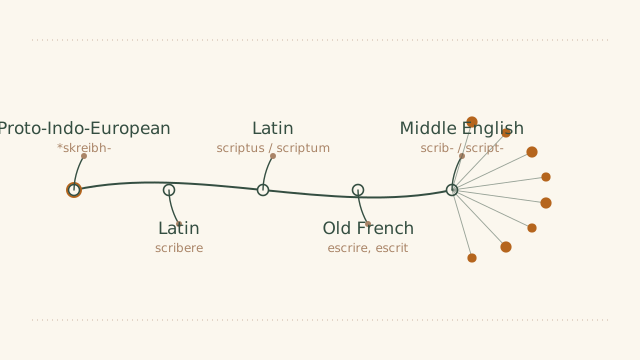
Etymology tree
Open any stage for the note attached to it.
-
01 Proto-Indo-European *skreibh-
to scratch, to cut into a surface
Writing began as scratching: the base also gives Latin scribere and, through a Germanic branch, English shrive and scribble's cousins in other languages.
-
02 Latin scribere
to write, to draw, to scratch
Latin used one verb for writing on wax, painting a line and drawing a boundary — the tool mattered less than the mark.
-
03 Latin scriptus / scriptum
written; a written thing
The participle is the source of the script- shape and of the noun scriptum, which English borrowed whole as script and scripture.
-
04 Old French escrire, escrit
to write; a writing
French added an e- before the initial s-, giving English the escrit- forms that survive in escritoire and in the older spelling of describe.
-
05 Middle English scrib- / script-
writing, written record
The Latin-learned compounds arrived after 1400, when English began borrowing directly rather than through French.
8 words · branching from the last stage
Stage by stage
| # | Stage | Form | What it meant |
|---|---|---|---|
| 1 | Proto-Indo-European | *skreibh- | to scratch, to cut into a surface |
| 2 | Latin | scribere | to write, to draw, to scratch |
| 3 | Latin | scriptus / scriptum | written; a written thing |
| 4 | Old French | escrire, escrit | to write; a writing |
| 5 | Middle English | scrib- / script- | writing, written record |
Writing began as scratching
The oldest sense of this root is physical: a stylus cutting into wax or stone. That is why inscription means writing that is cut into something, and why scribble — a word English formed from the root in the fifteenth century — means writing that looks like it was scratched out in a hurry. The technology changed; the metaphor stayed.
Latin used scribere for writing on wax tablets, drawing a line, and marking out a boundary. When Roman administrators needed a word for a written order, a written law or a written list of soldiers, they simply added a prefix. English received the results and has since added a few of its own, such as typescript and the software sense of script.
scrib- for verbs, script- for things
The two shapes divide the family almost perfectly, and the division is grammatical rather than alphabetical. Everything that is an action keeps the plain root: describe, prescribe, subscribe, inscribe, transcribe, circumscribe. Everything that is a thing or a state uses the participle: manuscript, transcript, script, inscription, prescription, subscription, conscription.
That rule also tells you something about how the word arrived. Words with the script- shape were usually taken from Latin directly, because they preserve the Latin participle ending; words that arrived through French often show an extra e- at the front — the older spelling of describe was descrive or descryve, and escritoire survives as the French-shaped noun.
- describe — de- + scribere, "write down" from a model or from memory
- prescribe — pre- + scribere, "write first", hence to lay down a rule or a course of treatment
- proscribe — "post up a name", hence to outlaw or forbid: the opposite of prescribe
- subscribe — sub- + scribere, "write underneath", originally a signature on a document
- circumscribe — "draw a line around", hence to limit or restrict
- transcribe — "write across", to move a text from one medium to another
The same root in two alphabets
The Greek cousin of this root is graphein, which covers the same ground and gave English its graph- family: graphic, diagram, photograph, biography. The two never merged, and English has kept them apart by register — scrib-/script- words tend to be legal and administrative, graph-/gram- words tend to be scientific and technical.
That gives a useful diagnostic. A manuscript is a text written by hand, whatever it is written about; a photograph is a record written by light, whatever it is written on. When both roots are available, the Latin one tends to name the document and the Greek one to name the process.
Kindred family
English words grown from this root, with the part of speech and a plain gloss.
| Word | Part of speech | Gloss |
|---|---|---|
| describe | verb | to write down what something is like |
| manuscript | noun | a text written by hand |
| prescribe | verb | to write down in advance; to order a treatment |
| transcript | noun | a text written across from another record |
| inscription | noun | writing cut into a surface |
| subscribe | verb | to write one's name underneath a document |
| scribble | verb | to write hastily or without care |
| conscript | noun | someone written onto the roll of soldiers |