
Root
mov / mot
to move
Latin movere is one of the great engines of English vocabulary: remove, promote, emotion, motive, mobile, momentum, commute. The three stems mov-, mot- and mob- all descend from the same verb, and mob came in through a Roman insult about the fickleness of crowds.
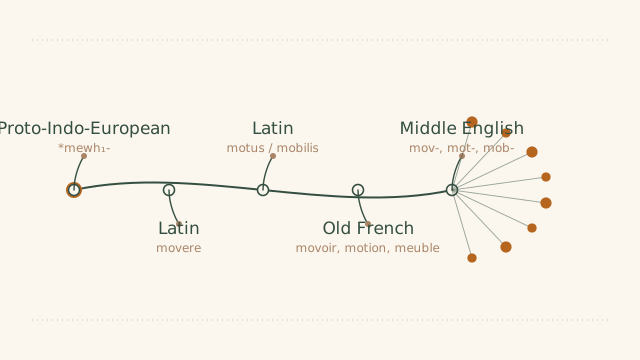
Etymology tree
Open any stage for the note attached to it.
-
01 Proto-Indo-European *mewh₁-
to push away, to move
The base behind Latin movere and, by a different route, Sanskrit kama, so move and the god of desire are distant cousins.
-
02 Latin movere
to move, to stir, to set in motion
A second-conjugation verb with an unusually large family in Latin, including the frequentative motare (to keep moving).
-
03 Latin motus / mobilis
a movement; movable
motus gives motion through French; mobilis gives mobile and the whole mobility family.
-
04 Old French movoir, motion, meuble
to move; movement; movable goods
French meuble meant movable property, which is why furniture and mobile share a root: furniture is literally the movable part of an estate.
-
05 Middle English mov-, mot-, mob-
movement, motion
The three stems went separate ways: mov- kept the plain sense, mot- the abstract, and mob- came through the Latin phrase mobile vulgus, "the fickle crowd".
8 words · branching from the last stage
Stage by stage
| # | Stage | Form | What it meant |
|---|---|---|---|
| 1 | Proto-Indo-European | *mewh₁- | to push away, to move |
| 2 | Latin | movere | to move, to stir, to set in motion |
| 3 | Latin | motus / mobilis | a movement; movable |
| 4 | Old French | movoir, motion, meuble | to move; movement; movable goods |
| 5 | Middle English | mov-, mot-, mob- | movement, motion |
The prefix turns the root
Almost every member of this family is a Latin compound of movere with a preposition, and the preposition does all the semantic work. E- (out) gives emotion and emigrate; pro- (forward) gives promote and propel; re- (back) gives remove and remit; com- (together) gives commotion and commute; de- (down) gives demote.
That is why the family feels so much larger than its root. Once you know movere means move, a word like demote parses as "move down", and promotion as "move forward" — and the same holds for a dozen less obvious members such as remote (moved far away) and motif (a thing that moves the design).
How mob got its meaning
The third stem, mob-, arrived through an odd route. The Latin phrase mobile vulgus meant "the fickle crowd", and English speakers of the 1680s shortened it to mob as a slang term for the rabble. It became a respectable word within a century, and then a verb in the twentieth century with the sense of crowding around someone.
That history explains why mob feels different from crowd. Crowd is neutral and came through Old English; mob always carries the older judgment that a moving mass of people is dangerous and changeable. It is one of the few words in the family whose emotional charge comes from the Roman phrase it was cut out of.
- remove — move back or away, from re- plus movere
- promote — move forward, and by extension advance in rank
- emotion — a moving out, originally of a physical disturbance
- commotion — a moving together, i.e. a noisy disturbance
- momentum — the Latin word for movement, given a precise physical meaning by Newton
- mob — a 1680s clipping of mobile vulgus, "the fickle crowd"
Movable property
One branch of the family is legal and financial rather than physical. In medieval French, meuble meant movable property, and English kept the distinction between movable goods and immovable land in the phrase movable property and in the older use of furniture itself, which is simply the French word for the movable part of an estate.
The same idea appears in mobile as a noun — first for a person's goods, then for a sculpture that moves — and in mobility, which since the twentieth century means both the ability to travel and the ability to rise in a social hierarchy. Social mobility is a metaphor taken so literally that the physical sense has almost vanished from the phrase.
Kindred family
English words grown from this root, with the part of speech and a plain gloss.
| Word | Part of speech | Gloss |
|---|---|---|
| movement | noun | the act of moving |
| motion | noun | movement; a formal proposal |
| mobile | adjective | able to move; movable |
| emotion | noun | a stirring up of feeling |
| motive | noun | that which moves one to act |
| promote | verb | to move forward; to advance |
| remove | verb | to move away again |
| momentum | noun | the quantity of motion in a body |