
Root
fer
to carry, to bear
Latin ferre, "to carry", is one of the oldest verbs in the family and one of the most irregular — its past participle was latum, which is why half its English descendants contain no f at all. It also carries a second sense, endurance, which split off early and survives in suffer.
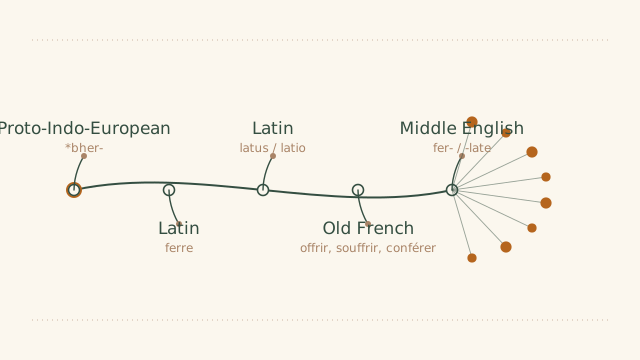
Etymology tree
Open any stage for the note attached to it.
-
01 Proto-Indo-European *bher-
to carry, to bear
One of the best-attested old bases. It gives Latin ferre, Greek pherein (as in Christopher, "bearer of Christ") and English bear itself.
-
02 Latin ferre
to carry, to bear, to endure
Irregular in Latin — ferre, tuli, latum — which is why its participle supplies the unrelated-looking lat- forms in English.
-
03 Latin latus / latio
carried; a carrying
From the same verb's participle stem. Translate, relate and collate belong to fer even though no f survives in them.
-
04 Old French offrir, souffrir, conférer
to offer, suffer, confer
French shortened several compounds so heavily that the root is barely visible: offer is ob- + ferre with the b gone.
-
05 Middle English fer- / -late
carrying, bearing
English inherited the verb compounds through French and then went back to Latin for a second wave: transfer, refer, prefer, confer.
8 words · branching from the last stage
Stage by stage
| # | Stage | Form | What it meant |
|---|---|---|---|
| 1 | Proto-Indo-European | *bher- | to carry, to bear |
| 2 | Latin | ferre | to carry, to bear, to endure |
| 3 | Latin | latus / latio | carried; a carrying |
| 4 | Old French | offrir, souffrir, conférer | to offer, suffer, confer |
| 5 | Middle English | fer- / -late | carrying, bearing |
Two senses that English split apart
Ferre meant both to carry something and to bear a weight, and English inherited both. Transfer, refer, prefer, differ and confer are all about moving something from one place to another. Suffer is about what a person bears: the word is sub- + ferre, "to carry from below", which is exactly the physical image of a load on someone's back. Offer is the same verb with ob-, "carry toward", and the b disappeared in French.
There is a third sense that looks unrelated and is worth noticing once: fertile is from fertilis, "bearing abundantly", built on the same verb stem with a different suffix. Once fertile is in the family, so are fecund's Latin relatives and the whole vocabulary of bearing fruit.
The lat- half of the family
Because Latin's irregular participle for ferre was latus, a large group of English words carries this root in the lat- shape. Translate carries meaning across languages; relate carries it back; collate carries texts together for comparison; ablation is the carrying away of material, in surgery and in glaciology alike.
This is the practical reason the entry exists. When a word with -late in it seems to have no etymology at all, the answer is usually ferre. The vowel is different and the consonant is gone, but the sense of something being moved is the same one that gives transfer its meaning.
- translate — trans- + latus, carried across from one language to another
- relate — re- + latus, carried back, hence a narrative that carries one thing back to another
- collate — com- + latus, carried together for comparison
- ablate / ablation — ab- + latus, carried away, hence surgical removal or the melting of a glacier
- elate — e- + latus, carried out of oneself, originally a word for being lifted up
- superlative — super- + latus, carried above everything else
Reading the prefix
The prefixes in this family behave consistently and are a fast way into academic vocabulary. Trans- across, re- back, pre- before, dif- apart, con- together, sub- from below, ob- toward, in- in. Add the ending -ence or -ance and you have the noun: transference, reference, preference, difference, conference, inference.
One warning: Latin had several verbs with ferre's shape that belong to other roots — ferrum (iron) gives ferrous and ferric; ferus (wild) gives feral; and some -fer words are native English coinages such as transferable and untransferable. Match a new word to the family by its prefix, not just by its letters.
Kindred family
English words grown from this root, with the part of speech and a plain gloss.
| Word | Part of speech | Gloss |
|---|---|---|
| transfer | verb | to carry across from one place or person to another |
| refer | verb | to carry back to a source; to direct attention |
| prefer | verb | to carry one thing in front of another; to like better |
| differ | verb | to carry apart; to be unlike |
| fertile | adjective | bearing abundantly |
| offer | verb | to carry something toward someone |
| suffer | verb | to bear from below; to undergo pain |
| confer | verb | to bring together for discussion; to grant |