
Root
ten / tain / tin
to hold, to keep
Latin tenere, "to hold", is behind contain, maintain, retain, obtain and a dozen more — the family is so large that English speakers use several of its members every day without noticing they are related. The spellings -tain, -ten and -tent all come from the same verb by different routes.
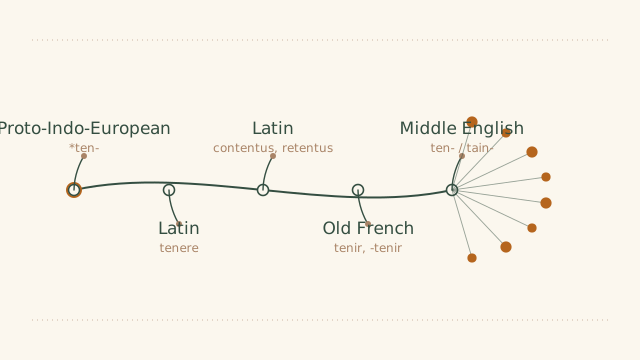
Etymology tree
Open any stage for the note attached to it.
-
01 Proto-Indo-European *ten-
to stretch, to pull tight
The base means stretching rather than holding; holding came to be expressed by the same verb because a stretched thing is held taut.
-
02 Latin tenere
to hold, to keep, to grasp
A second-conjugation verb whose compounds are everywhere in English. Its own relatives include tenax (tenacious) and tendere (to stretch), which split into a whole separate family.
-
03 Latin contentus, retentus
held together; held back
The past participle -tentus is the source of content, patent, intent and extent, all of them "held" in some direction.
-
04 Old French tenir, -tenir
to hold
French shifted the vowel to -tenir, which is why English has both -tain (maintain, contain) and -ten (retention, tenant) spellings.
-
05 Middle English ten- / tain-
hold, keep
One of the most productive Latin roots in English because Latin used tenere for every kind of keeping, from land to opinions.
8 words · branching from the last stage
Stage by stage
| # | Stage | Form | What it meant |
|---|---|---|---|
| 1 | Proto-Indo-European | *ten- | to stretch, to pull tight |
| 2 | Latin | tenere | to hold, to keep, to grasp |
| 3 | Latin | contentus, retentus | held together; held back |
| 4 | Old French | tenir, -tenir | to hold |
| 5 | Middle English | ten- / tain- | hold, keep |
The prefix does the work
This root rewards a mechanical approach more than almost any other in English. Take the verb tenere and add a Latin preposition, and the meaning is almost always predictable: con- (together) plus tenere is contain, re- (back) is retain, ob- (against, toward) is obtain, sus- (from below, a form of sub-) is sustain, per- (through) is pertain.
A handful of members have drifted far enough to need separate learning. Entertain originally meant to hold someone in a certain state of mind, and only later came to mean to amuse. Maintain meant to hold in the hand, which is why it still suggests effort: you maintain a car or an argument, and both take work.
The -tent nouns
The past participle of tenere produced a set of abstract nouns that are now completely independent words. Content is what is held within something; patent is what lies open (from patere, to lie open, with the ten- element arrived by analogy); intent is a holding toward; extent is a holding out; portent is a holding forth of meaning.
Patent is the odd one out etymologically — it comes from Latin patens, "lying open", and its -tent ending is a later respelling under the influence of the ten- family. It is a good reminder that not every word containing a familiar letter sequence contains the root.
- content — held together, hence what a thing contains
- intent — a holding toward, hence a purpose
- extent — a holding out, hence a size or degree
- retention — a holding back, in medicine and in business alike
- tenant — one who holds land
- tenure — the holding of an office or property, and in academia a permanent post
Holdings in law and school
The legal sense is old and central: tenant, tenure, tenement and the whole apparatus of property law built on the idea that a person holds land rather than owns it absolutely. Tenure still means the conditions under which something is held, and in universities it means a post that is held permanently.
Tenacious and tenacity keep the physical sense of gripping, and are used both literally and figuratively: a tenacious grip, a tenacious memory, a tenacious negotiator. The root's original meaning, "to stretch", survives most purely in the separate family around tendere — tension, extend, tendon — which is worth learning alongside this one.
Kindred family
English words grown from this root, with the part of speech and a plain gloss.
| Word | Part of speech | Gloss |
|---|---|---|
| contain | verb | to hold together inside |
| maintain | verb | to hold in the hand; to keep up |
| tenant | noun | one who holds land |
| retention | noun | the act of holding back |
| tenacious | adjective | holding on tightly |
| content | noun | that which is held within |
| detain | verb | to hold away; to keep back |
| abstain | verb | to hold oneself from |