
Root
aud / audi
to hear
Latin audire, "to hear", came into English through the law courts before it came through the loudspeaker. Audience and audit were both legal words for centuries; the acoustic senses (audio, audiology, audiobook) are all nineteenth- and twentieth-century coinages.
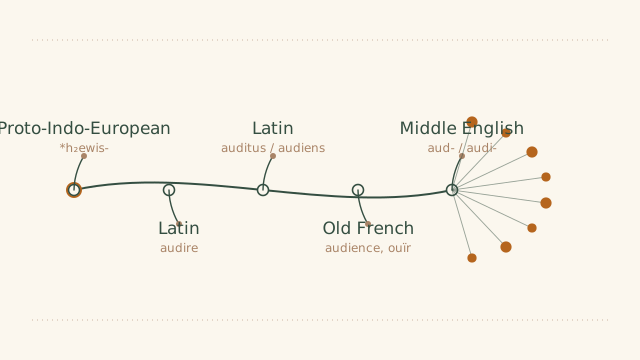
Etymology tree
Open any stage for the note attached to it.
-
01 Proto-Indo-European *h₂ewis-
to perceive, to hear
The base appears in Greek aisthanesthai (to perceive), which gives English aesthetic — a relative of audit that almost nobody recognises as one.
-
02 Latin audire
to hear, to listen to
A fourth-conjugation verb; its compounds in Latin were mostly legal, which is why the modern family leans administrative before it leans acoustic.
-
03 Latin auditus / audiens
heard; a hearing
The noun auditus gives English audit and auditory; the participle audiens gives audience and the legal audi alteram partem.
-
04 Old French audience, ouïr
a hearing; to hear
French ouïr survived in legal English as oyez, the crier's call that opens a court session.
-
05 Middle English aud- / audi-
hearing, listening
Until the twentieth century the family was almost entirely legal and religious; audio, audiology and audiobook are all modern coinages.
8 words · branching from the last stage
Stage by stage
| # | Stage | Form | What it meant |
|---|---|---|---|
| 1 | Proto-Indo-European | *h₂ewis- | to perceive, to hear |
| 2 | Latin | audire | to hear, to listen to |
| 3 | Latin | auditus / audiens | heard; a hearing |
| 4 | Old French | audience, ouïr | a hearing; to hear |
| 5 | Middle English | aud- / audi- | hearing, listening |
A legal root before an acoustic one
In Latin, audire built its compounds in the courts. An audit was the formal hearing of accounts, a practice that stayed oral far longer than modern readers assume — the auditor literally listened while figures were read out. An audience was a hearing granted by someone in authority, which is why the word still means both a group of spectators and a formal meeting with a head of state.
That legal flavour survives in English in phrases that have nothing to do with sound. To audit a course is to sit in without credit, which preserves the older sense of attending and hearing rather than examining. An audit trail is a paper record, but the word still carries the idea of an authoritative hearing.
The modern sensory branch
Audio was not an English word until the twentieth century. It was taken from the Latin "I hear" in the 1920s to label the sound half of broadcast transmission, in deliberate parallel with video, and it has since become an ordinary noun (an audio file, an audio interface).
The rest of the modern family is clinical or technical: audiology dates from the 1940s, audiometer and audiogram from earlier in the century, and audiobook was coined in the 1950s and only became common in the 1980s. All of them were built by the same method, attaching a Greek or Latin suffix to the Latin stem.
- audience — first recorded in English for a formal hearing, then for a theatre crowd
- audit — a hearing of accounts, later the inspection itself
- audio — Latin "I hear", adopted as the partner term to video in the 1920s
- audition — a hearing given to a candidate performer; also the medical sense of hearing
- audiology — the study of hearing, coined in the 1940s
- audiobook — 1950s coinage, common only from the 1980s
The relative nobody spots
One of the most surprising members of this family is aesthetic. It comes from Greek aisthanesthai, "to perceive", which descends from the same Indo-European base as audire. The connection is not a curiosity: in both branches the root idea is perception by the senses rather than thought, and the Greek word simply leaned toward the whole sensory apparatus while Latin specialised in hearing.
The same base is present in anaesthesia, "without perception", which is why the oldest member of the family in English involves hearing, and one of the newest involves not feeling anything at all.
Kindred family
English words grown from this root, with the part of speech and a plain gloss.
| Word | Part of speech | Gloss |
|---|---|---|
| audience | noun | those who hear; a formal hearing with a ruler |
| audit | noun | an official hearing of accounts |
| audio | noun | sound reproduced or transmitted; from the Latin "I hear" |
| inaudible | adjective | not able to be heard |
| auditorium | noun | a place for hearing |
| audition | noun | a hearing given to a performer |
| auditory | adjective | relating to hearing |
| audiology | noun | the study of hearing |