
Root
phon
sound, voice
Greek phone meant voice and sound, and the nineteenth century turned it into the most productive root in audio technology: telephone, phonograph, microphone, megaphone. The older Greek compounds — symphony, cacophony — still describe how sounds behave together.
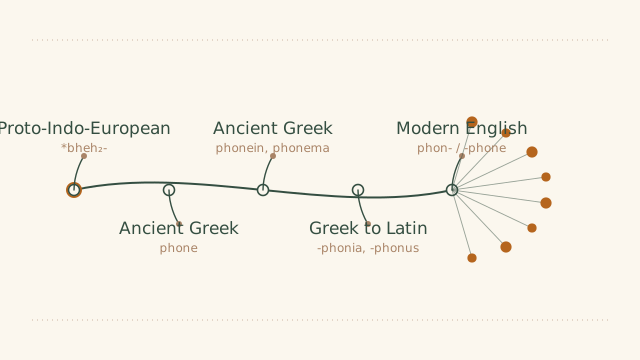
Etymology tree
Open any stage for the note attached to it.
-
01 Proto-Indo-European *bheh₂-
to speak, to sound
The base behind Greek phone and Latin fari (to speak), which gives English fame, fable and infant.
-
02 Ancient Greek phone
voice, sound
Both the human voice and any sound; Greek also used it for the sound of an instrument.
-
03 Ancient Greek phonein, phonema
to make a sound; a sound made
phonema is the source of phoneme, the smallest unit of sound in a language.
-
04 Greek to Latin -phonia, -phonus
voice of a certain kind
Used in compounds such as symphonia (sounding together) and kakophonia (bad sound).
-
05 Modern English phon- / -phone
sound; a device for sound
The nineteenth century made the root technical: telephone, phonograph, microphone — all coined within fifty years of each other.
8 words · branching from the last stage
Stage by stage
| # | Stage | Form | What it meant |
|---|---|---|---|
| 1 | Proto-Indo-European | *bheh₂- | to speak, to sound |
| 2 | Ancient Greek | phone | voice, sound |
| 3 | Ancient Greek | phonein, phonema | to make a sound; a sound made |
| 4 | Greek to Latin | -phonia, -phonus | voice of a certain kind |
| 5 | Modern English | phon- / -phone | sound; a device for sound |
Voice before device
In Greek the word covered the human voice first and any sound second, and several compounds from that period are still in use without any machinery attached. Symphony was simply "a sounding together" of voices or instruments. Cacophony was bad sound, and euphony was good sound, and both words are still used to judge prose as much as music.
The root also produced the vocabulary of phonetics and phonology, where it names the smallest units of speech. Phoneme was coined in the 1870s from the Greek word for a sound made, and it remains the technical term for a unit of sound that distinguishes one word from another.
The nineteenth century made it technical
Almost every device word in this family was coined within about sixty years. Telephone appeared in the 1830s for an earlier signalling device and was reapplied to Bell's instrument in 1876. Phonograph followed in 1877, microphone in 1878, and megaphone in 1878 as well — all three built from the same Greek root, in the same decade, by different inventors.
The pattern then became a general suffix. Once -phone was established as "device for sound", anyone could coin headphone, earphone, saxophone, vibraphone and telephone exchange without consulting Greek. That is how a dead language stays productive in the patent office.
- telephone — 1876 for Bell's instrument, but the word had been used for a signalling device since the 1830s
- phonograph — 1877, literally "sound writer", the machine that cut sound into a cylinder
- microphone — 1878, "small sound", originally a name for a carbon contact device
- megaphone — 1878, "big sound", a speaking trumpet
- gramophone — 1887, a trademark that became generic in Britain
- saxophone — 1846, named after Adolphe Sax, the instrument maker
Traps in the family
The pairs to keep apart are those built on opposite Greek prefixes. Euphony and cacophony are judgments about sound, not devices. Homophone is about words that sound alike but are spelled differently, while homonym covers both those and words that are spelled alike — a distinction that examiners like.
One more trap is in the spelling of the suffix. English writes -phone for devices and -phony for qualities of sound, and the two are not interchangeable: a symphony is a piece of music, a symphonic work is written for orchestra, and a phone is a phone.
Kindred family
English words grown from this root, with the part of speech and a plain gloss.
| Word | Part of speech | Gloss |
|---|---|---|
| telephone | noun | sound carried from far away |
| phonetics | noun | the study of speech sounds |
| symphony | noun | a sounding together of instruments |
| cacophony | noun | a bad sound; a harsh mixture of noises |
| megaphone | noun | a device for making a voice large |
| phoneme | noun | the smallest distinctive unit of sound |
| saxophone | noun | the "Sax sound", named after its inventor |
| phonograph | noun | a device that writes sound |