
Root
chron
time
Greek chronos was measurable duration, as opposed to kairos, the right moment — a distinction English lost by borrowing only the first. The root now covers clockwork (chronometer), sequence (chronology), repetition (chronic) and simultaneity (synchronise, asynchronous).
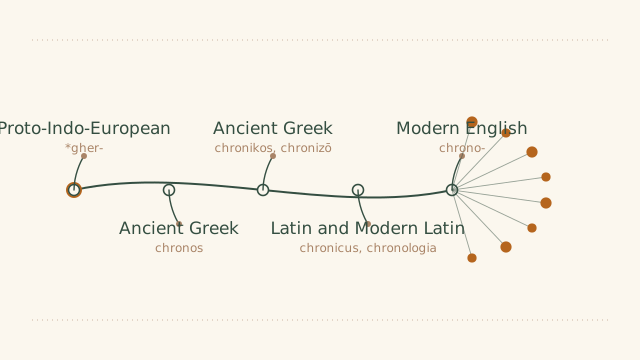
Etymology tree
Open any stage for the note attached to it.
-
01 Proto-Indo-European *gher-
to rub, to grind away
The same base that gives Greek chronos and, through a different path, Latin granum (grain) — time imagined as what wears things down.
-
02 Ancient Greek chronos
time, a span of time, delay
Greek had two time words: chronos, measurable duration, and kairos, the right or critical moment. English borrowed only chronos.
-
03 Ancient Greek chronikos, chronizō
of time; to spend time, to linger
chronizō meant both to take a long time and to be late — the medical sense of "chronic" as long-lasting grows out of this.
-
04 Latin and Modern Latin chronicus, chronologia
of time; the ordering of time
chronologia was coined in the 1580s for the science of dating events, and is the oldest of the modern scientific chron- words.
-
05 Modern English chrono-
time; sequence in time
Now covers both measurement (chronometer, chronology) and simultaneity (synchronise, chronological, asynchronous).
8 words · branching from the last stage
Stage by stage
| # | Stage | Form | What it meant |
|---|---|---|---|
| 1 | Proto-Indo-European | *gher- | to rub, to grind away |
| 2 | Ancient Greek | chronos | time, a span of time, delay |
| 3 | Ancient Greek | chronikos, chronizō | of time; to spend time, to linger |
| 4 | Latin and Modern Latin | chronicus, chronologia | of time; the ordering of time |
| 5 | Modern English | chrono- | time; sequence in time |
Two kinds of time
The Greeks kept chronos and kairos apart, and the difference matters more than it first appears. Chronos is time as a quantity: hours, seasons, the length of a war. Kairos is time as an opportunity: the moment when the argument can be won, the instant a bowstring should be released. English borrowed chronos and let kairos stay in Greek, where it survives mainly in theology.
That single borrowing decision shaped the whole vocabulary. Every English word with chron- is about duration, measurement or sequence, because the word it was built on only ever meant those. There is no English word descended from kairos that means "the right moment" in ordinary use.
From chronicles to clocks
Chronology is the oldest scientific member, coined in the 1580s when scholars were trying to establish a single timeline for ancient history from conflicting sources. Chronicle came earlier through Old French and is essentially the same word in its medieval form: a record arranged by time, and for centuries the standard form of historical writing.
The technological members arrived with the need to navigate. A chronometer in the eighteenth century meant a clock accurate enough to determine longitude at sea, and the problem it solved — keeping time across weeks of rolling and varying temperature — was the hardest engineering problem of its age. Synchronise came later, in the 1620s, for making two clocks agree.
- chronicle — from Old French, a record arranged by time
- chronic — 1400s in the medical sense, from Greek chronikos
- chronology — 1580s, the science of dating events
- synchronise — 1620s, to make things agree in time
- chronometer — 1731, a clock precise enough for navigation
- anachronism — 1640s, from Greek ana (against) plus chronos
Time in machines
The twentieth century gave the root a second life in computing, where the problems are the same ones the navigators had. Asynchronous describes operations that do not share a clock, and the word became ordinary with the rise of the web: an asynchronous request is one that does not block, and an async function is one that returns later.
Cron, the Unix job scheduler, is named directly from chronos, and it produced the back-formed cron job — a phrase whose users mostly have no idea it contains a Greek word for time. The pattern is typical of technical borrowing: the classical root survives, in disguise, in the least literary places.
Kindred family
English words grown from this root, with the part of speech and a plain gloss.
| Word | Part of speech | Gloss |
|---|---|---|
| chronological | adjective | arranged in order of time |
| chronic | adjective | lasting a long time; of long duration |
| synchronise | verb | to give the same time to; to happen together |
| chronometer | noun | an instrument for measuring time precisely |
| anachronism | noun | something placed out of its proper time |
| asynchronous | adjective | not happening at the same time |
| chronicle | noun | a record arranged by time |
| chronology | noun | the ordering of events in time |