
Root
cred
to believe, to trust
Latin credere means both to believe and to lend, and English kept both senses: credit is money entrusted and reputation earned, while credible and credence are about belief. One root, two registers, and a set of adjectives that examiners like.
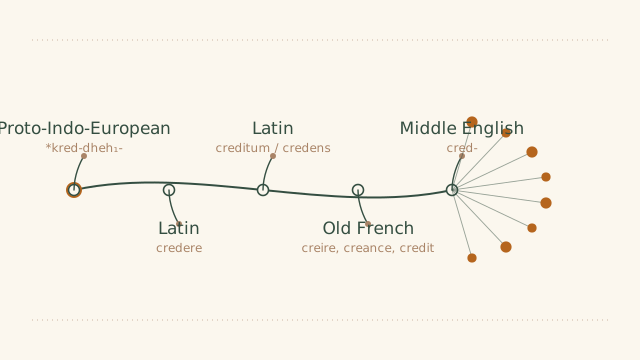
Etymology tree
Open any stage for the note attached to it.
-
01 Proto-Indo-European *kred-dheh₁-
to place one's heart, to trust
A compound of "heart" and "to put". Trust was imagined as placing your heart with someone, and the same metaphor underlies the Latin and the Sanskrit forms.
-
02 Latin credere
to believe, to trust, to entrust
One verb covers believing a claim and lending money — the financial sense is not a later invention but an original one.
-
03 Latin creditum / credens
something entrusted, a loan; believing
The noun creditum is a loan in both senses of the English word, which is why credit came to mean both reputation and borrowing power.
-
04 Old French creire, creance, credit
to believe; belief; credit
French passed credence and credit into English in the financial and diplomatic senses first.
-
05 Middle English cred-
belief, trust, reputation
Credo and creed came through the church, credit through the counting house; the two lines only met again in modern English.
8 words · branching from the last stage
Stage by stage
| # | Stage | Form | What it meant |
|---|---|---|---|
| 1 | Proto-Indo-European | *kred-dheh₁- | to place one's heart, to trust |
| 2 | Latin | credere | to believe, to trust, to entrust |
| 3 | Latin | creditum / credens | something entrusted, a loan; believing |
| 4 | Old French | creire, creance, credit | to believe; belief; credit |
| 5 | Middle English | cred- | belief, trust, reputation |
Trust as lending
The double sense is original, not a metaphor that got out of hand. In Latin you could credere alicui pecuniam — entrust money to someone — and credere alicui — believe someone. The noun creditum meant both a loan and a thing believed, and English inherited the ambiguity intact: a credit is money someone trusts you with, and credit is the trust itself.
This is why the financial and reputational senses of credit can appear in one sentence without contradiction. A credit rating measures whether you can be believed about money. A discredited witness and a discredited loan have both had belief withdrawn from them.
The three adjectives
English built three adjectives on this root and gave each of them a separate job, which makes them a favourite in vocabulary tests. Credible means believable: a credible account. Credulous means inclined to believe: a credulous investor. Creditable means worthy of praise: a creditable performance, from the sense of credit as esteem.
There is a fourth, incredulous, which is the negative of credulous and describes a person refusing to believe — not to be confused with incredible, which describes a thing that cannot be believed and, in colloquial use, a thing that is simply very good.
- credible — believable: a credible threat, a credible source
- incredible — not believable; colloquially, excellent
- credulous — too willing to believe, always about a person
- incredulous — refusing to believe, also about a person
- creditable — deserving credit or praise
- credentialed — holding the papers that make one credible
Belief in institutions
The word has moved with the institutions that use it. Credentials were originally letters given by a ruler to an ambassador, proving the bearer could be trusted — which is why credential has a formal, diplomatic flavour and why credentialism, coined in the 1970s, is a criticism of hiring by paper qualification.
In modern finance the root has expanded faster than anywhere else: credit card, credit line, credit default swap, carbon credit, microcredit. Every one of them keeps the original idea of a promise that something will be made good later, which is exactly what credere meant when it was applied to money in Rome.
Kindred family
English words grown from this root, with the part of speech and a plain gloss.
| Word | Part of speech | Gloss |
|---|---|---|
| credit | noun | belief in someone's solvency; a sum entrusted |
| incredible | adjective | not able to be believed |
| credential | noun | that which gives one credit; a proof of authority |
| creed | noun | a statement of belief |
| credence | noun | belief; the acceptance of a claim as true |
| discredit | verb | to take credit away; to damage belief in |
| creditor | noun | one to whom money is owed |
| credo | noun | a statement of principles; Latin for "I believe" |