
Root
vid / vis
to see
Latin videre, "to see", sits behind two of the most common letters in academic English: vid- and vis-. It also carries an older sense of knowing, inherited from a root where seeing and understanding were the same act, and that older sense survives in provide, prudent and evident.
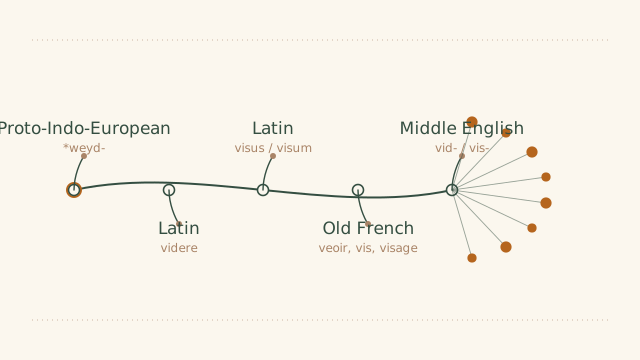
Etymology tree
Open any stage for the note attached to it.
-
01 Proto-Indo-European *weyd-
to see, to know
Seeing and knowing were one idea in this base, which is why the Greek cousin is oida, "I know", and the Sanskrit veda means knowledge.
-
02 Latin videre
to see, to perceive
A plain second-conjugation verb whose passive participle visus is the source of the whole vis- half of the family.
-
03 Latin visus / visum
seen; a sight
Vision, visible, visual and visa all come from this participle rather than from the infinitive.
-
04 Old French veoir, vis, visage
to see; face; face, appearance
French kept the vis- shape in nouns of appearance: visage, visor, and the dance term vis-à-vis.
-
05 Middle English vid- / vis-
seeing, sight
English re-borrowed the Latin forms from the fourteenth century onward, which is why the learned words sit beside the French-shaped ones.
8 words · branching from the last stage
Stage by stage
| # | Stage | Form | What it meant |
|---|---|---|---|
| 1 | Proto-Indo-European | *weyd- | to see, to know |
| 2 | Latin | videre | to see, to perceive |
| 3 | Latin | visus / visum | seen; a sight |
| 4 | Old French | veoir, vis, visage | to see; face; face, appearance |
| 5 | Middle English | vid- / vis- | seeing, sight |
Seeing meant knowing
The Indo-European base behind this verb covered both sight and knowledge, and the two never fully separated. That is why evident means something you can see and therefore know, why provide means to see ahead and therefore prepare, and why the Latin phrase for "it is obvious" was simply videtur, "it is seen".
Greek kept the same link with a different word: oida, "I know", is formally a perfect tense of a verb meaning to see, so the Greek verb for knowing literally says "I have seen". The Sanskrit veda has the same shape and the same double sense, which is why the oldest Indian texts are called the Vedas — bodies of knowledge.
Two shapes, one rule
The infinitive gave English vid- words and the participle gave it vis- words, with very few exceptions. Visible, vision, visual, visualise, visa and television all use the participle. Video, evident, provide, revise, divide and individual use the infinitive form — though individual is worth a warning, since its second element is not videre but a related adjective.
The prefix behaves exactly as it does across the rest of the Latin vocabulary. Pro- plus videre is to see ahead; re- plus videre is to see again; super- plus videre is to see from above; tele- (Greek, "far") plus visus is to see at a distance — a hybrid coinage from 1900 that mixes a Greek prefix with a Latin root, which is normal in scientific naming.
- evident — e- + videre, "able to be seen out", hence obvious
- provide — pro- + videre, "see ahead", hence to prepare or supply
- revise — re- + videre, "see again", hence to look over and correct
- supervise — super- + videre, "look over from above"
- television — Greek tele + Latin visus, "seeing at a distance"
- video — the Latin word for "I see", chosen in 1950s broadcasting as the partner of audio
Where the root stops being obvious
Two very common words hide this root completely. Prudent is a worn-down form of providens, "foreseeing", and providence is the same idea given a theological name. Envy comes from invidere, "to look at with malice", from in- plus videre — the evil eye was literal in Latin.
A visit, meanwhile, is not a sight but a going to see: visitare was a frequentative of visere, itself a form of videre. English has kept the noun long after the verb narrowed to the point where visiting no longer implies looking at anything.
Kindred family
English words grown from this root, with the part of speech and a plain gloss.
| Word | Part of speech | Gloss |
|---|---|---|
| evident | adjective | able to be seen clearly; obvious |
| provide | verb | to see ahead and supply what is needed |
| revise | verb | to see again; to look over and correct |
| supervise | verb | to look over from above |
| vision | noun | the faculty of sight; something seen ahead |
| invisible | adjective | not able to be seen |
| video | noun | literally "I see", from the first word of the Latin broadcast formula |
| visa | noun | a document that has been seen and approved |