
Root
duc / duct
to lead, to draw along
Latin ducere, "to lead", is a root about movement with a direction: water down a channel, troops into battle, heat along a wire, an argument toward a conclusion. Because direction is carried by the prefix, one root gives you a dozen verbs that differ only at the front.
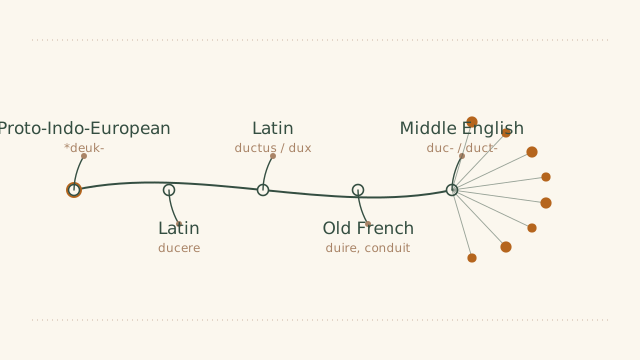
Etymology tree
Open any stage for the note attached to it.
-
01 Proto-Indo-European *deuk-
to draw, to pull along
The same base shows up in Latin dux (leader) and in German ziehen (to pull), which is why the two look unrelated but behave alike.
-
02 Latin ducere
to lead, to guide, to draw
One of the busiest verbs in Latin: it also carried the sense of drawing a line, pulling a cart and leading troops.
-
03 Latin ductus / dux
led; leader
The participle gives English its duct- shape, and dux gives duke — a leader by title rather than by verb.
-
04 Old French duire, conduit
to lead; a channel
French softened the Latin c- into a vowel in several descendants, which is where conduit and the -duit- spelling come from.
-
05 Middle English duc- / duct-
leading, conducting
Introduced through both French and later Latin borrowings; the technical sense (a duct for air or fluid) is seventeenth-century.
8 words · branching from the last stage
Stage by stage
| # | Stage | Form | What it meant |
|---|---|---|---|
| 1 | Proto-Indo-European | *deuk- | to draw, to pull along |
| 2 | Latin | ducere | to lead, to guide, to draw |
| 3 | Latin | ductus / dux | led; leader |
| 4 | Old French | duire, conduit | to lead; a channel |
| 5 | Middle English | duc- / duct- | leading, conducting |
The verb and its two families
Latin ducere covered a wide field: to lead an army, to draw a line, to pull a cart, to bring a person somewhere. Its past participle ductus gave English its second shape, and in technical writing that shape took on a life of its own — a duct is simply something that leads a fluid, and ductile describes metal that can be drawn out into wire without breaking.
The everyday verbs came the other way, through Old French, and they kept the plain duc- spelling: produce, reduce, introduce, conduct. When you meet a new word in this family, the useful question is not what ducere means — you already know — but which direction the prefix is pointing.
Read the prefix, get the word
Because Latin stacked prefixes onto the same verb, English inherited sets of near-identical words whose only real difference is direction. This is the cheapest vocabulary in the language once the prefixes are known: six prefixes are worth six words, and the pattern holds even for words you have never seen.
The same mechanism explains the technical vocabulary. Conduction is heat or charge being led through a material; induction is something being led in — a current into a coil, or a person into an office; reduction is leading something back to a smaller state. The metaphors were literal in Latin and only became abstract in English.
- in- (into): induce, induct, induction
- e-/ex- (out): educe, educt
- se- (apart): seduce, seduction — leading someone aside
- pro- (forward): produce, product, production
- re- (back): reduce, reduction, reductio
- con- (together): conduct, conductor, conduit
Spelling: duct, duit and duke
Three spellings of one root are in circulation, and they follow the route the word took rather than any rule about meaning. Words that came through French often lost the c to a vowel: conduit, and the -duit- in it, sit beside conduct and the -duct- in that. Words that came straight from Latin or were coined in English keep the c: ductile, aqueduct, viaduct, abduction.
Duke sits at the edge of the family. It comes from Latin dux, "leader", which is the same base as ducere but a noun formed from it — a leader as a person rather than as an action. That is why duke has no c at all and yet belongs here: the title and the verb are two branches of one root.
Kindred family
English words grown from this root, with the part of speech and a plain gloss.
| Word | Part of speech | Gloss |
|---|---|---|
| conduct | verb | to lead or guide; to carry heat, sound or electricity |
| induce | verb | to lead someone into something; to bring about |
| produce | verb | to lead forward out of something; to make |
| reduce | verb | to lead back; to make smaller |
| abduct | verb | to lead someone away by force |
| ductile | adjective | able to be drawn out into wire; easily led |
| viaduct | noun | a bridge that carries a road over a valley |
| aqueduct | noun | a channel that leads water |