
Root
port
to carry, to bring across
Latin portare, "to carry", is the most literal root in this yard: nothing abstract ever happened to it. A harbour, a portfolio, an export licence and a USB port all name a place or a moment where something is carried from one side to the other.
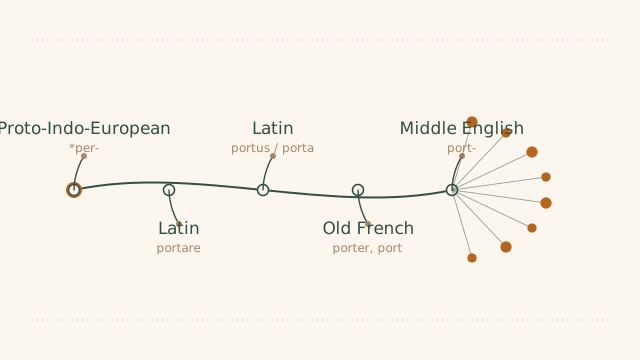
Etymology tree
Open any stage for the note attached to it.
-
01 Proto-Indo-European *per-
to cross, to pass through
One of the oldest bases in the family; it also underlies English ferry, ford and the Greek poros (passage).
-
02 Latin portare
to carry, to transport
A workhorse verb with no prefixed compounds of its own in early Latin — its compounds were formed later and mostly outside Latin.
-
03 Latin portus / porta
harbour; gate
Two nouns from the same base. A harbour is where things are carried across; a gate is where things are carried through.
-
04 Old French porter, port
to carry; a carrying place
French passed the verb into English twice, once as the working verb to port and once inside import, export and report.
-
05 Middle English port-
carrying, carrying place
The harbour sense settled first (a place where goods are carried to), and only later did port come to mean the left side of a ship.
8 words · branching from the last stage
Stage by stage
| # | Stage | Form | What it meant |
|---|---|---|---|
| 1 | Proto-Indo-European | *per- | to cross, to pass through |
| 2 | Latin | portare | to carry, to transport |
| 3 | Latin | portus / porta | harbour; gate |
| 4 | Old French | porter, port | to carry; a carrying place |
| 5 | Middle English | port- | carrying, carrying place |
A verb that never went abstract
Portare is one of the plainest verbs Latin had, and it stayed plain. Where specere drifted into meanings about judgment and ducere into meanings about persuasion, portare kept its physical sense through two thousand years: goods, people, water and data are all still carried. The most abstract descendant in common use, report, is only one step away — news is information carried back to someone who was not there.
Two nouns come from the same base and are worth keeping apart from the verb: portus, a harbour, and porta, a gate. Both are places where carrying happens, which is why port means both a harbour and a data socket, and why a door in French is still a porte.
Direction is the whole meaning
Because the root itself carries no direction, every compound gets its meaning entirely from the prefix, and the pattern is so regular that new coinages follow it automatically. Transport companies move goods across; an import duty is charged on goods carried in; a deportee is carried out of a country against their will; support is what holds a thing from underneath.
This is worth testing when you meet a technical term. If a system is described as portable it can be carried between machines; if a language bindings layer is called a transport it is moving data between two endpoints; a port number identifies which doorway the data is being carried through.
- in- (into): import, importation
- ex- (out): export, exportation
- trans- (across): transport, transportation
- de- (away): deport, deportation
- sup- (from below): support, supporter
- re- (back): report, reporter — carrying the news back
Where the root hides
Two of the most common words in this family do not look like port words at all. Portfolio is Italian: portafoglio, "carry a leaf", from portare + foglio, a sheet — the same construction as the English carry-case, and the financial sense (a portfolio of investments) is only a century old. Opportunity has already been mentioned above and is the other false friend: its port is a harbour, but its meaning is about a favourable wind rather than carrying.
The technical descendants are the ones that keep the root most alive today. Portable document format, port forwarding, transport layer security: each one names a thing being carried and a direction, exactly as the Latin did.
Kindred family
English words grown from this root, with the part of speech and a plain gloss.
| Word | Part of speech | Gloss |
|---|---|---|
| transport | verb | to carry across from one place to another |
| portable | adjective | able to be carried |
| import | verb | to carry goods into a country |
| export | verb | to carry goods out of a country |
| report | noun | news carried back; a formal account |
| portfolio | noun | a case for carrying loose papers; a set of holdings |
| deport | verb | to carry a person away out of a country |
| support | verb | to carry from below |