
Root
mit / miss
to send, to let go
Latin mittere covered both sending and releasing, and English took both: admit, transmit and dismiss on one side, promise and permit on the other. The family splits cleanly into mit- verbs and miss- nouns, and the split follows the Latin participle.
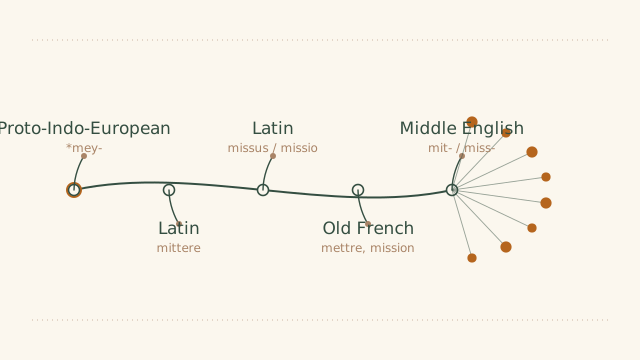
Etymology tree
Open any stage for the note attached to it.
-
01 Proto-Indo-European *mey-
to change place, to go
The same base underlies Latin migrare (to migrate), which is why migration and mission feel like cousins even though they look different.
-
02 Latin mittere
to send, to let go, to release
Both senses are old: sending a messenger and letting a thing go from the hand are the same verb in Latin.
-
03 Latin missus / missio
sent; a sending
The participle doubled the s, which is why the family splits into mit- words and miss- words with no overlap.
-
04 Old French mettre, mission
to put, a sending
French reduced mittere to mettre, which is why English also has permit, submit and commit in the -mit shape rather than with a full participle.
-
05 Middle English mit- / miss-
sending, releasing
The religious sense of mission arrived first, in the fourteenth century; the military and diplomatic senses are later.
8 words · branching from the last stage
Stage by stage
| # | Stage | Form | What it meant |
|---|---|---|---|
| 1 | Proto-Indo-European | *mey- | to change place, to go |
| 2 | Latin | mittere | to send, to let go, to release |
| 3 | Latin | missus / missio | sent; a sending |
| 4 | Old French | mettre, mission | to put, a sending |
| 5 | Middle English | mit- / miss- | sending, releasing |
Sending and letting go
The verb had two senses from the beginning, and English inherited them in separate words. Emissary, missile, mission and transmit all involve something being sent somewhere. Permit, remit, dismiss and admit lean toward the releasing sense — to permit something is to let it go through, and to dismiss is to let someone go away.
That double sense explains an oddity in the modern family. A remittance is money sent, but the verb remit can also mean to cancel a debt or to send a case back to a lower court. Both come from the same Latin: the thing being sent back is sometimes money, sometimes an obligation, and sometimes a legal matter.
mit- in the verb, miss- in the noun
Latin's participle missus doubled the s, and English kept the distinction with unusual consistency. Every -mit verb has a -miss- noun behind it: admit/admission, permit/permission, omit/omission, transmit/transmission, submit/submission, remit/remission, commit/commission. Learn one and you get the other free, including the doubled consonant in the spelling.
The exceptions are informative rather than annoying. Committee keeps the double consonant but changes the vowel; commissioner drops one m; mess — from missus, a portion of food sent to the table — has drifted so far that most speakers would not connect it to mission at all.
- admit / admission — the second d and the second s both come from the Latin prefixes
- permit / permission — permit also shifted stress in the noun: PER-mit against per-MIT
- transmit / transmission — the -ss- survives intact
- omit / omission — omission drops one m in the noun
- commit / commission — the double letters swap places between the two words
- submit / submission — submission has the same -ss- and the same stress shift as permit
The modern technical family
Mittere is the root behind a large part of the vocabulary of telecommunications, and the words are literal: to transmit is to send across, to emit is to send out, to remit is to send back, and the noun emission is quite simply a sending out. Radio engineering adopted the Latin vocabulary wholesale in the 1890s and has not needed to replace it since.
The computing register has added one twist. A commit in version control is a handing over of changes, which is what the Latin commitere (to bring together, to entrust) meant before it narrowed. The same verb gives commitment, committee and committal, and the sense of entrusting something runs through all three.
Kindred family
English words grown from this root, with the part of speech and a plain gloss.
| Word | Part of speech | Gloss |
|---|---|---|
| admit | verb | to send toward; to allow entry, or to concede a fact |
| transmit | verb | to send across |
| dismiss | verb | to send away |
| submit | verb | to send under; to yield to authority, or to hand in |
| missile | noun | a thing sent through the air |
| remit | verb | to send back; to send money, or to cancel a debt |
| emissary | noun | someone sent out |
| promise | noun | something sent forward in words |