
Root
ject
to throw, to cast
Latin iacere, "to throw", survived into English almost entirely inside compounds, one per preposition: project forward, reject back, inject in, eject out, object against, subject under. That regularity makes the family one of the easiest in the language to decode.
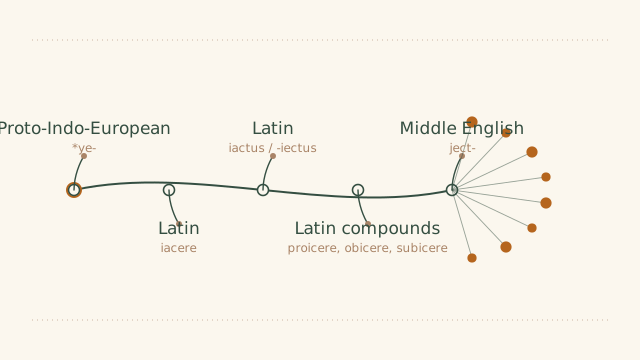
Etymology tree
Open any stage for the note attached to it.
-
01 Proto-Indo-European *ye-
to throw
A base with few English descendants outside Latin, which makes the ject family unusually self-contained.
-
02 Latin iacere
to throw, to cast, to lay
The verb is iacere; the -ject form appears in compounds, where the initial i- was absorbed by the prefix.
-
03 Latin iactus / -iectus
a throw; thrown
The frequentative iactare (to keep throwing) gives English jet, jetty and jactitation.
-
04 Latin compounds proicere, obicere, subicere
to throw forward, against, under
Latin built dozens of these; English took almost all of them, which is why the family is dominated by its compounds rather than its base verb.
-
05 Middle English ject-
throw, cast
Almost no English word uses ject without a prefix; the bare verb iacere never entered the language.
8 words · branching from the last stage
Stage by stage
| # | Stage | Form | What it meant |
|---|---|---|---|
| 1 | Proto-Indo-European | *ye- | to throw |
| 2 | Latin | iacere | to throw, to cast, to lay |
| 3 | Latin | iactus / -iectus | a throw; thrown |
| 4 | Latin compounds | proicere, obicere, subicere | to throw forward, against, under |
| 5 | Middle English | ject- | throw, cast |
One verb, many prepositions
The ject family is the clearest demonstration in English of how Latin built vocabulary. The base verb iacere meant to throw, and Latin attached prepositions to it to produce a set of verbs whose meanings are entirely predictable from their parts. English took almost the whole set, often twice, once through French and once directly from Latin.
That double borrowing explains pairs like project and projection, or reject and rejection, where the noun came through French with a different stress pattern. It also explains why the family contains no bare verb: there is no English word ject, because the unprefixed form never made the journey.
The two heavyweights
Object and subject carry more weight than the rest of the family combined, because each developed abstract senses in philosophy, grammar and law. Subject is what is thrown under: a person under a ruler, a topic under discussion, a noun phrase under a predicate. Object is what is thrown against: something that stands opposed, something presented to the mind, a noun phrase that receives the action.
The pair produced a matching pair of adjectives with opposite meanings. Subjective is what belongs to the thinking subject, hence personal and possibly biased; objective is what belongs to the object, hence impartial and verifiable. The whole vocabulary of the objectivity debate in philosophy and journalism rests on two Latin prepositions.
- project — thrown forward: a plan, or to cast an image forward
- reject — thrown back: to refuse
- subject — thrown under: topic, person under rule, grammatical subject
- object — thrown against: thing, aim, grammatical object, to oppose
- trajectory — thrown across: the path of a moving body
- conjecture — thrown together: a guess built from scattered evidence
The modern technical life
Engineering and computing have taken several of these words and given them precise new senses. Injection in medicine is literal; in computing, dependency injection is metaphorical but keeps the direction — a dependency is pushed in from outside rather than created internally. Eject is standard for drives and for aircraft seats.
Projection has gone furthest: it means the casting of an image onto a surface, the representation of a three-dimensional object on a plane, the attribution of one's own feelings to another person, and a forward estimate in statistics. All four senses are the same throw, aimed at different targets.
Kindred family
English words grown from this root, with the part of speech and a plain gloss.
| Word | Part of speech | Gloss |
|---|---|---|
| project | noun | something thrown forward; a plan |
| reject | verb | to throw back |
| inject | verb | to throw into |
| subject | noun | thrown under; that which is under discussion or rule |
| object | noun | thrown against; a thing placed before the mind |
| eject | verb | to throw out |
| trajectory | noun | the path of something thrown across |
| adjacent | adjective | thrown near to; lying next to |