
Word
muscle
contractile tissue that produces movement; strength
Muscle is Latin musculus, "little mouse" — Roman writers thought a flexing biceps looked like a mouse moving under the skin, and the Greek word for muscle, mys, makes the same comparison. The sense of power, as in military muscle, is a nineteenth-century American extension.
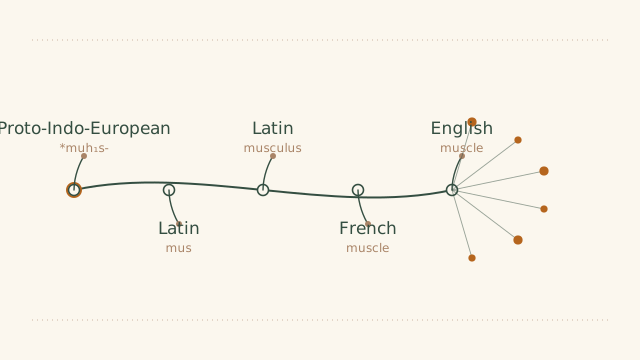
Etymology tree
Open any stage for the note attached to it.
-
01 Proto-Indo-European *muh₁s-
mouse
The base is the ordinary word for mouse, which is why the Latin, Greek and English words for the animal all look alike.
-
02 Latin mus
mouse
A small, common word; its diminutive musculus, "little mouse", was used for a variety of small objects.
-
03 Latin musculus
little mouse; a muscle
Roman writers used musculus for a muscle because a flexing biceps looks like a mouse running under the skin — the same observation appears in Greek mys.
-
04 French muscle
muscle
French passed the word into English in the 1500s, along with a large anatomical vocabulary borrowed from Latin.
-
05 English muscle
contractile tissue; strength, influence
The figurative sense of power — military muscle, financial muscle — is nineteenth-century and American in origin.
6 words · branching from the last stage
Stage by stage
| # | Stage | Form | What it meant |
|---|---|---|---|
| 1 | Proto-Indo-European | *muh₁s- | mouse |
| 2 | Latin | mus | mouse |
| 3 | Latin | musculus | little mouse; a muscle |
| 4 | French | muscle | muscle |
| 5 | English | muscle | contractile tissue; strength, influence |
A mouse under the skin
The comparison is one of the oldest in anatomy and it appears independently in two languages. Greek called a muscle mys, a mouse, and Latin called it musculus, a little mouse, because the shape of a contracted biceps — a rounded mass with a narrow tendon at each end — resembles a small animal with a tail. Neither language needed a separate technical coinage.
Latin musculus was also used for several other small rounded objects, including a kind of mollusc and a battering ram with a covered roof. That is how the same word produced both muscle and mussel, two English words that sound identical and have nothing to do with each other in ordinary use.
The anatomical vocabulary arrives
English took muscle from French in the 1500s, in the same wave of borrowing that brought artery, tendon, ligament and the rest of the anatomical vocabulary into the language. Before that, English used the Old English word for the flesh, and the technical term simply did not exist.
For centuries muscle meant only the tissue. Its use as a metaphor for strength is recent and American: the phrase "military muscle" appears in the late nineteenth century, and "financial muscle" in the twentieth. The slang sense of muscle as influence, as in "to muscle in on a deal", follows the same period.
- musculus (Latin) — little mouse, muscle
- muscle (French, 1500s) — the tissue
- muscular — the adjective, and by the 1700s also a description of prose style
- muscle in (verb) — 1920s American slang for intruding
- military muscle — late 1800s, the metaphor of force as a body part
- muscle memory — mid twentieth century, the idea that repeated movement becomes automatic
Why the metaphor works
The word has proved durable because the thing it describes is visible. Unlike most anatomical terms, which are Latin loans that never escaped medicine, muscle is an ordinary noun with an everyday referent: everyone has felt one move and seen one change shape. That is why it transferred so easily to power, and why "flexing" — a movement of the arm — became a metaphor for displaying strength.
It also explains why the word appears in idioms that have nothing to do with anatomy. To muscle in is to push your way into a situation; muscle memory is the body's knack for a repeated action; and a muscle-bound argument is one whose strength is all show. The mouse of Roman anatomy has had a busy second life.
Kindred family
Cousins of this word across the languages it travelled through.
| Word | Part of speech | Gloss |
|---|---|---|
| mouse | noun | the animal, from Old English mus |
| muscular | adjective | having well-developed muscle; forceful |
| mysophobia | noun | a fear of dirt, from Greek mys (mouse), not from muscle |
| mussel | noun | the shellfish, from Latin musculus, which also meant a kind of mollusc |
| musette | noun | a small bagpipe, from the French diminutive of muser — a different word with the same shape |
| mus | noun | the genus name for mice in modern zoology |