
Word
nice
pleasant, agreeable; formerly: foolish, then precise, then fastidious
Nice is the standard English example of semantic bleaching: it entered the language meaning foolish, drifted through fastidious and precise, and ended up meaning pleasant. It comes from Latin nescius, "ignorant" — literally "not knowing".
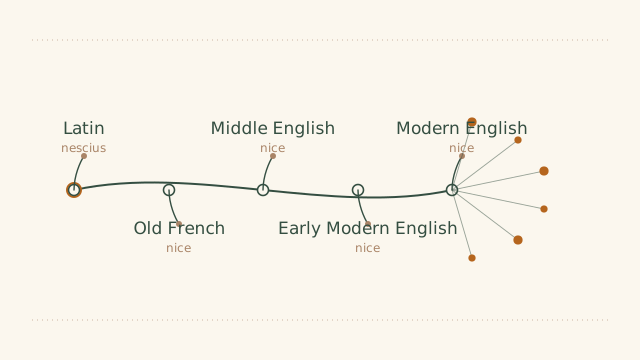
Etymology tree
Open any stage for the note attached to it.
-
01 Latin nescius
ignorant, not knowing
A contraction of ne (not) plus scire (to know) — the same scire that gives science and conscience.
-
02 Old French nice
foolish, simple, careless
French carried the Latin word north and kept the negative sense intact for centuries.
-
03 Middle English nice
foolish, wanton, strange, shy
Chaucer uses it for folly; by the 1500s it had picked up the sense of "particular, hard to please".
-
04 Early Modern English nice
precise, minute, fastidious, refined
A "nice distinction" in the 1600s meant a very fine one, and a "nice young lady" meant a fastidious one — not a compliment.
-
05 Modern English nice
pleasant, agreeable, kind
The modern sense of general approval is eighteenth-century and was criticised at the time for being vague. It won anyway.
6 words · branching from the last stage
Stage by stage
| # | Stage | Form | What it meant |
|---|---|---|---|
| 1 | Latin | nescius | ignorant, not knowing |
| 2 | Old French | nice | foolish, simple, careless |
| 3 | Middle English | nice | foolish, wanton, strange, shy |
| 4 | Early Modern English | nice | precise, minute, fastidious, refined |
| 5 | Modern English | nice | pleasant, agreeable, kind |
A word that meant the opposite
When nice arrived in English in the 1200s it meant foolish or simple-minded, and that sense persisted for three hundred years. Chaucer uses it for folly and for wantonness; a fourteenth-century writer could call someone nice and mean that they were stupid or morally loose. Every later sense is a weakening of the original insult.
The path from foolish to fastidious ran through a middle sense of "strange" or "shy", and it makes a kind of sense: someone who does not know is awkward, someone awkward is over-particular, someone over-particular is precise. By the 1600s nice had become almost a term of praise for accuracy — a nice observer was a careful one, a nice distinction a fine one.
The eighteenth-century collapse
The final shift happened in the 1700s, when nice began to be used as a general word of approval for almost anything. Contemporaries noticed and disliked it: critics complained that nice had become the laziest adjective in the language, applied to food, weather, people and ideas without distinguishing between them.
They were right about the vagueness and wrong about the outcome. Nice settled into the slot it occupies today, the mildest possible positive. Its older senses survive only in a handful of fixed phrases — a nice distinction, nice and early — where the meaning depends entirely on the context.
- 1200s–1400s — foolish, wanton, simple
- 1400s–1500s — strange, shy, coy
- 1500s–1600s — fastidious, over-particular
- 1600s–1700s — precise, subtle, finely judged (a nice distinction)
- 1700s–present — pleasant, agreeable (the sense condemned as vague at the time)
- fixed survivals — nice and early, a nice point, nice work
The same root without the bleaching
The Latin source of nice has fared very differently elsewhere. Nescius was built from ne plus scire, "not to know", and the scire half produced a large and stable family: science, conscience, conscious, omniscient, prescient. None of those words moved an inch from "knowing".
Nescient itself survives in English as an exact synonym of ignorant, unchanged in meaning since Latin. So the same root produced both the most precise vocabulary in the language and its vaguest adjective, which is a good illustration of how differently borrowed words can behave.
Kindred family
Cousins of this word across the languages it travelled through.
| Word | Part of speech | Gloss |
|---|---|---|
| nescient | adjective | ignorant, lacking knowledge — the unweakened Latin sense |
| science | noun | from scire, to know |
| conscience | noun | knowing with oneself; moral awareness |
| conscious | adjective | knowing with; aware |
| omniscient | adjective | knowing everything |
| prescient | adjective | knowing beforehand |