
Root
path
feeling, suffering, disease
Greek pathos covered suffering, experience and emotion in one word, which is why the English words built on it run from pathology to sympathy to apathy without ever leaving the same idea: something is happening to someone, and they feel it.
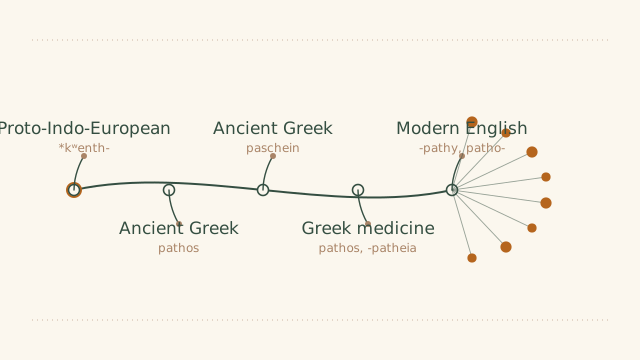
Etymology tree
Open any stage for the note attached to it.
-
01 Proto-Indo-European *kʷenth-
to suffer, to endure
The base also lies behind Latin pati (to suffer), which gives patient and passion — an entirely separate English family on the same idea.
-
02 Ancient Greek pathos
suffering, experience, emotion
The noun Aristotle used for the emotions a tragedy should arouse in its audience.
-
03 Ancient Greek paschein
to suffer, to be affected
The verb is passive in shape: to be affected by something, hence both to feel and to be harmed.
-
04 Greek medicine pathos, -patheia
a condition of the body; a suffering
Hippocratic writers used pathos for anything that happened to a body, healthy or not, which is how the root entered medicine with the neutral sense of "condition".
-
05 Modern English -pathy, patho-
disorder; feeling; treatment by a method
Three senses now run in parallel: disease (pathology), feeling (sympathy, empathy), and therapeutic method (osteopathy, homeopathy).
8 words · branching from the last stage
Stage by stage
| # | Stage | Form | What it meant |
|---|---|---|---|
| 1 | Proto-Indo-European | *kʷenth- | to suffer, to endure |
| 2 | Ancient Greek | pathos | suffering, experience, emotion |
| 3 | Ancient Greek | paschein | to suffer, to be affected |
| 4 | Greek medicine | pathos, -patheia | a condition of the body; a suffering |
| 5 | Modern English | -pathy, patho- | disorder; feeling; treatment by a method |
One word for being affected
The Greek verb paschein is passive in sense — to undergo, to be acted upon — and its noun pathos names whatever state that undergoing produces. A wound is a pathos; a strong emotion is a pathos; an illness is a pathos. The Hippocratic writers therefore used it for any condition of the body at all, and medicine inherited the word with that wide meaning.
English then split the inheritance into three parts. The medical branch kept the disease sense and built pathology, pathogen, neuropathy and dozens of named disorders. The psychological branch kept the emotion sense and built sympathy, antipathy and apathy. The therapeutic branch used it to name methods of treatment, which is how osteopathy and homeopathy came to mean what they mean.
Empathy is a modern coinage
The most interesting member of the family is the newest. Empathy was invented in 1909 by the psychologist Edward Titchener to translate the German Einfühlung, "feeling into", a term from aesthetics for the way a viewer projects themselves into a work of art. It had nothing to do with suffering when it was coined and only became a common word after the 1950s.
That history explains why empathy and sympathy are not synonyms. Sympathy has been in English since the 1570s and originally meant an affinity between things — the sympathy of two tuning forks — before it narrowed to shared feeling between people. Empathy arrived much later with a different job: understanding from inside, by an act of imagination, what another person's experience is like.
- sympathy — 1570s, first for natural affinity between things, then shared feeling
- antipathy — 1600s, a settled dislike, literally "feeling against"
- apathy — 1600s, from Greek apatheia, freedom from passion; the modern sense of indifference is later
- pathology — 1600s, first "the study of the passions", medical sense from the 1700s
- empathy — 1909, Titchener's translation of Einfühlung
- telepathy — 1882, coined by Frederic Myers for the Society for Psychical Research
Reading the medical set
In clinical vocabulary the root is entirely mechanical and carries no emotional weight. A pathogen produces disease; a pathology is either the disease process or the study of it; neuropathy is damage to nerves; cardiomyopathy is disease of heart muscle. The prefix tells you where, and the -pathy tells you that something is wrong with it.
This makes the medical branch easy to read once you know the anatomy prefixes, and it is where most new members of the family appear. The psychological branch is nearly closed — sympathy, empathy, antipathy, apathy and their adjectives are the whole set — which is unusual for such a productive root.
Kindred family
English words grown from this root, with the part of speech and a plain gloss.
| Word | Part of speech | Gloss |
|---|---|---|
| sympathy | noun | feeling with another |
| empathy | noun | feeling into another's experience |
| pathology | noun | the study of disease |
| apathetic | adjective | without feeling |
| pathogen | noun | a producer of disease |
| antipathy | noun | feeling against; a settled dislike |
| telepathy | noun | feeling at a distance |
| homeopathy | noun | treatment by similar suffering |