
Word
quarantine
a period of isolation imposed to prevent the spread of disease
Quarantine is named after a number: quaranta, forty, the days a ship suspected of plague had to wait before landing. Venice formalised the practice in the fourteenth century, and the word has since detached from its number entirely.
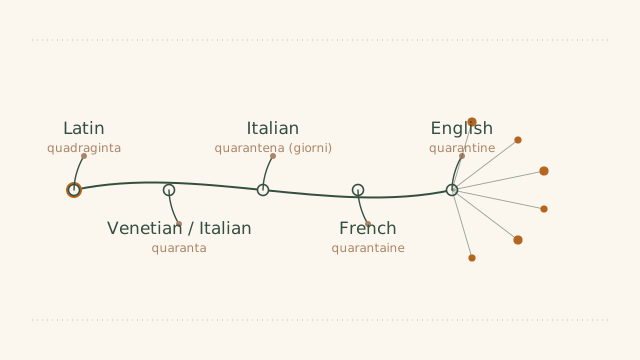
Etymology tree
Open any stage for the note attached to it.
-
01 Latin quadraginta
forty
The number is the whole word: quarantine is named after a count of days, not after a disease.
-
02 Venetian / Italian quaranta
forty
Venice and Ragusa (modern Dubrovnik) ran the first systematic maritime quarantine systems in the fourteenth century.
-
03 Italian quarantena (giorni)
forty days
Ragusa's 1377 ordinance specified a month; Venice settled on forty days, a number with Biblical and medical associations.
-
04 French quarantaine
a period of forty; a ship's isolation
French also used quarantaine for a person's forties, a sense English borrowed as well.
-
05 English quarantine
isolation to prevent contagion; any imposed isolation
By the nineteenth century the number had detached: a quarantine could be any length the authorities chose.
6 words · branching from the last stage
Stage by stage
| # | Stage | Form | What it meant |
|---|---|---|---|
| 1 | Latin | quadraginta | forty |
| 2 | Venetian / Italian | quaranta | forty |
| 3 | Italian | quarantena (giorni) | forty days |
| 4 | French | quarantaine | a period of forty; a ship's isolation |
| 5 | English | quarantine | isolation to prevent contagion; any imposed isolation |
Forty days in the Adriatic
The practice came before the word. When the Black Death reached the Mediterranean in 1347, the trading cities of the Adriatic responded with rules about ships arriving from infected ports. Ragusa, now Dubrovnik, issued an ordinance in 1377 requiring arriving vessels to wait a month before unloading; Venice established a permanent station on an island in the lagoon and settled on forty days.
Forty was not an arbitrary choice. It had Biblical weight from the flood, the desert and the fast, and medical authority from the Hippocratic tradition held that a disease incubated in about that time. The Venetian term quarantena giorni — forty days — became the name of the institution rather than the length of any particular stay.
The number falls away
The word spread through every European language and left its number behind almost immediately. English quarantine appears in the 1500s for a period of isolation whose length was set by the port authority, and by the 1700s the number forty was a historical footnote. Ships were quarantined for ten days, twenty, or as long as the local board decided.
The practice also produced a durable vocabulary. A lazaret, from the Italian lazzaretto, was the building where the isolation happened, and the word still names quarantine stations in the Mediterranean. Bills of health, the certificates that a ship was disease-free, were the documents that decided whether a quarantine was imposed at all.
- 1377 — Ragusa requires arriving ships to wait a month
- 1403 — Venice establishes a permanent quarantine station on Santa Maria di Nazareth
- 1500s — the word enters English as a period of isolation set by the port
- 1700s — the forty-day length is abandoned in favour of variable periods
- 1892 — the word is applied to people rather than ships in routine public health use
- 2020 — the sense extends to mass domestic isolation, which is not the historical meaning
What the word does not mean
Quarantine originally referred to a ship and its crew, and the unit was the vessel. The modern use of the word for whole populations confined to their homes is a genuine extension rather than a return to the original — the older systems isolated people who arrived, not people who stayed put.
It is also worth keeping quarantine distinct from isolation in the technical sense. Quarantine applies to those who have been exposed and may become ill; isolation applies to those who are ill. The distinction matters in epidemiology, and it is one of the few places where a word that has lost its number has gained a precise modern meaning instead.
Kindred family
Cousins of this word across the languages it travelled through.
| Word | Part of speech | Gloss |
|---|---|---|
| quarantine | noun | forty days, and by extension any isolation period |
| quarantaine | noun | French for both the isolation and one's forties |
| quadragenarian | noun | a person in their forties — the same Latin number, undamaged |
| quart | noun | a quarter, from quartus (fourth) — the same numeral family |
| quarrel | noun | a dispute, from Latin querela — unrelated, but spelled alike enough to confuse |
| carestia | noun | Italian for famine, a reminder of what quarantine was protecting against |