
Word
salary
a fixed regular payment for work
Salary comes from the Latin salarium, an allowance connected with salt — a story that is broadly true and almost always over-told. The word arrived in English through legal French in the 1300s as a fixed payment for service, with no salt left in it at all.
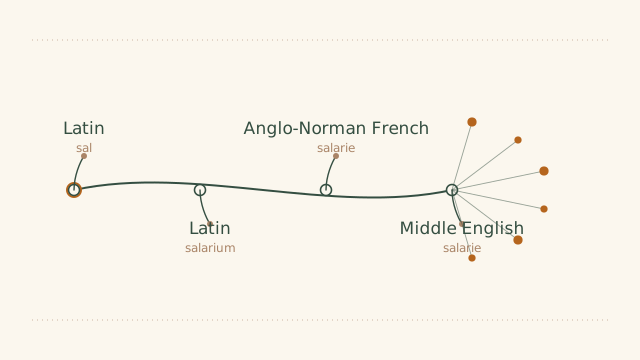
Etymology tree
Open any stage for the note attached to it.
-
01 Latin sal
salt
Salt was the standard Roman preservative and one of the few commodities every household needed in quantity.
-
02 Latin salarium
an allowance for salt; a soldier's allowance
The word appears in Roman texts as an allowance paid to soldiers and officials, though whether it was literally for buying salt is disputed by historians.
-
03 Anglo-Norman French salarie
payment, recompense
Legal French carried the word into English records in the fourteenth century, at first alongside the native word fee.
-
04 Middle English salarie
a fixed payment for service
By the 1400s the salt connection was already a footnote and the word simply meant a regular payment, as it does today.
6 words · branching from the last stage
Stage by stage
| # | Stage | Form | What it meant |
|---|---|---|---|
| 1 | Latin | sal | salt |
| 2 | Latin | salarium | an allowance for salt; a soldier's allowance |
| 3 | Anglo-Norman French | salarie | payment, recompense |
| 4 | Middle English | salarie | a fixed payment for service |
What the Romans actually paid
Salarium appears in Roman sources as a payment, often to soldiers or officials, and it is connected with sal, salt. That much is agreed. What is not agreed is whether the payment was literally a salt allowance, a sum given so that the recipient could buy salt, or simply a word that had drifted into meaning any allowance at all.
The historian Pliny the Elder mentions salt as a payment in his Natural History, in a passage about the people who lived near the salt works, but he is describing an unusual arrangement rather than a general practice. The safest version of the story is the one the etymology supports: the word means "salt money", and what it bought in practice is a matter of scholarship.
From allowance to contract
In medieval England the Latin word arrived twice, once through the church and once through the courts, and settled as salarie in the records of the 1300s. At that point it meant a fixed sum paid at intervals for a service performed — a sense close to the modern one, though the social range was wider.
The word's meaning has been remarkably stable since. Salary never developed a slang sense, never became a metaphor, and never split into dialects. It simply names the thing it names, which is unusual for a common noun that has been in the language for seven hundred years.
- sal (Latin) — salt
- salarium — an allowance connected with salt
- salarie (Anglo-Norman French) — payment, recompense
- salarie (Middle English, 1300s) — a fixed payment for service
- salary (modern) — regular income from employment
- salaried — the adjective that marks a staff position rather than hourly work
Salt in the rest of English
The salt family in English is large and mostly invisible, because the Latin and the Germanic branches arrived separately. Salt itself came through Old English, while the learned words — saline, salinity, saliferous — came from Latin. Salad and salsa both descend from "salted" and entered from opposite ends of the Mediterranean.
One more relative is worth noticing for the confusion it causes. Soldier looks as though it should belong here, but it comes from solidus, a Roman gold coin, and means "one paid in solidi". It arrived at the same idea by a completely different road, which is why soldiers earn a salary without any salt in either word.
Kindred family
Cousins of this word across the languages it travelled through.
| Word | Part of speech | Gloss |
|---|---|---|
| salt | noun | the mineral itself, via Old English sealt |
| saline | adjective | salty, containing salt |
| salami | noun | salted meat, from Italian salame |
| salsa | noun | sauce, literally "salted" |
| salad | noun | from herba salata, salted greens |
| soldier | noun | one paid, from Latin solidus, a coin — a different root that converged on the same idea |