
Root
spec / spect / spic
to look at, to observe
Latin specere, "to look at", is one of the most productive roots in academic English, and it arrives in three shapes: spec-, spect- and spic-. Learn the shapes and a large block of vocabulary stops being arbitrary.
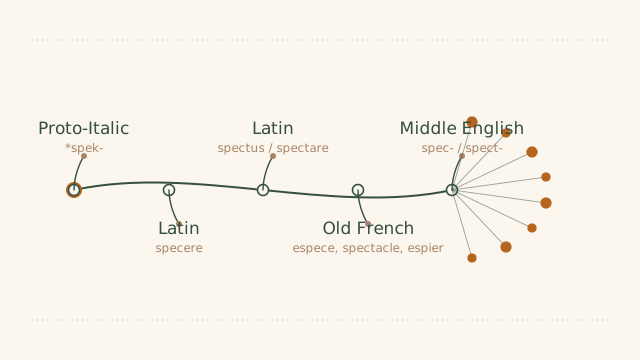
Etymology tree
Open any stage for the note attached to it.
-
01 Proto-Italic *spek-
to watch, to keep an eye on
Reconstructed from Latin, Oscan and Umbrian descendants. The asterisk is the standard mark for a form no text preserves.
-
02 Latin specere
to look at, to observe
The plain verb. Compounds with prefixes were already common in classical Latin: inspicere, conspicere, suspicere.
-
03 Latin spectus / spectare
looked at; to watch repeatedly
Latin built frequentative verbs on past participles. This -t- is the reason English has both spec- and spect- words.
-
04 Old French espece, spectacle, espier
kind, show, to watch
French carried the spect- words into English after 1066, often with the vowel shifted and an e- added in front of initial s-.
-
05 Middle English spec- / spect-
productive in learned borrowings
From the sixteenth century English took Latin words whole again, which is where specimen, spectrum and specify come from.
8 words · branching from the last stage
Stage by stage
| # | Stage | Form | What it meant |
|---|---|---|---|
| 1 | Proto-Italic | *spek- | to watch, to keep an eye on |
| 2 | Latin | specere | to look at, to observe |
| 3 | Latin | spectus / spectare | looked at; to watch repeatedly |
| 4 | Old French | espece, spectacle, espier | kind, show, to watch |
| 5 | Middle English | spec- / spect- | productive in learned borrowings |
Where the root came from
The root goes back to a Proto-Italic form reconstructed as *spek-, recovered from Latin, Oscan and Umbrian rather than read in any surviving text. Latin inherited it as specere, a plain verb meaning to look at or observe. Nothing about the verb is remarkable on its own; what made it useful later is that Roman writers built an enormous vocabulary on top of it, and English borrowed that vocabulary twice — once through medieval French, and then again directly from Latin in the sixteenth and seventeenth centuries.
The participle spectus is why the second shape exists. Latin regularly formed frequentative verbs on past participles, so spectus produced spectare, "to watch repeatedly", and the -t- travelled with the word through French into English. That is why respect, inspect and suspect appear in the spect- shape while specimen and spectrum, taken straight from Latin centuries later, keep the plain spec-.
The three shapes and the trap inside the third
spec- appears when the root takes a suffix rather than a prefix, or follows a prefix that keeps the short e intact: specimen, spectacle, spectrum, specify. spect- covers almost every verb and adjective built with a Latin prefix, because those were formed on the participle: inspect, respect, suspect, prospect, retrospect, circumspect.
The trap is spic-. When a prefix ending in a consonant swallows the vowel of the root, specere turns into spicere inside the compound: conspicuous and perspicacious both hide the verb in their second syllable, and so do perspicuous and the much rarer transpicious. Learners who train themselves to hunt for spect- walk straight past conspicuous, which is one of the most frequent words in the family.
- inspect — to look into: in- adds direction here, not negation
- respect — re- + specere, "to look back at", which became "to regard with consideration"
- suspect — sub- + specere with the prefix assimilated to sus-, literally "to look up from below"
- conspicuous — com- + spicere, "to look together", where the prefix eats the root vowel
- perspicacious — per- + spicere, "to see through" a problem rather than around it
- prospect — pro- + spectus, a view stretching ahead of you
How far the family reaches
The row count in the table above is the argument for learning this root first: inspect, respect, suspect, prospect, spectacle, spectator, specimen, spectrum, conspicuous, perspicacious, specify — and spy, which came through Old French espier and therefore shares the root without sharing a single letter of its modern shape.
The root is still productive, but in science and engineering the new compounds are international coinages rather than English ones. Spectrometer, spectrograph and spectroscope were all assembled in the nineteenth century from Latin and Greek parts, and each of them means something is being sorted or measured by the light it gives off. Recognising spec- in a technical word usually gets you that far before you look it up.
Kindred family
English words grown from this root, with the part of speech and a plain gloss.
| Word | Part of speech | Gloss |
|---|---|---|
| inspect | verb | to look at something closely and officially |
| respect | verb | to look back at with consideration; to hold in esteem |
| suspect | verb | to look up at someone; to think likely guilty |
| spectator | noun | one who watches an event |
| conspicuous | adjective | clearly visible; attracting notice |
| specimen | noun | a single example looked at as representative |
| prospect | noun | a view ahead; a future possibility |
| perspicacious | adjective | seeing through a matter quickly; shrewd |