
Root
struct / stru
to build, to pile up
Latin struere meant to pile up, and building was imagined as layering: straw and strew share the same prehistoric base. The family splits neatly into things built physically (structure, construct, destroy) and things built into people or systems (instruct, instrument, institution).
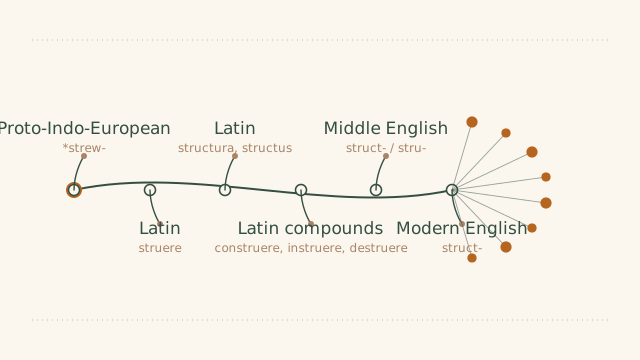
Etymology tree
Open any stage for the note attached to it.
-
01 Proto-Indo-European *strew-
to spread, to strew
The base behind Latin struere (to pile up) and also behind English strew and straw — building as layering things on top of one another.
-
02 Latin struere
to build, to arrange, to pile up
A third-conjugation verb used for walls, armies and arguments alike — Latin could struere a case as readily as a house.
-
03 Latin structura, structus
a building, an arrangement; built
structura gave English structure directly, the only member of the family that came in without a prefix.
-
04 Latin compounds construere, instruere, destruere
to build together, to equip, to tear down
The compounds carry most of the meaning: in- here means "into place", so instruere meant to arrange or equip rather than to teach.
-
05 Middle English struct- / stru-
building, arrangement
-
06 Modern English struct-
build, arrangement
Productive in engineering, computing and linguistics: infrastructure, constructor, restructure, deconstruct.
8 words · branching from the last stage
Stage by stage
| # | Stage | Form | What it meant |
|---|---|---|---|
| 1 | Proto-Indo-European | *strew- | to spread, to strew |
| 2 | Latin | struere | to build, to arrange, to pile up |
| 3 | Latin | structura, structus | a building, an arrangement; built |
| 4 | Latin compounds | construere, instruere, destruere | to build together, to equip, to tear down |
| 5 | Middle English | struct- / stru- | building, arrangement |
| 6 | Modern English | struct- | build, arrangement |
Building as piling up
The oldest sense of this root is not architecture but stacking. Its Indo-European ancestor meant to strew or spread, and the same base gave English straw — the material you spread on a floor. Latin struere kept the idea of laying things in order, and used it for brick, for battle lines and for arguments.
That breadth explains why the family is so varied. Structure is simply the Latin noun, the only member that arrived without a prefix. Construct, destroy, obstruct, instruct and instrument are all compounds, and each one names a direction in which something is piled: together, apart, in the way, into someone, into place.
The abstract branch
Instruction began as a physical metaphor and never entirely lost it. Latin instruere meant to fit out or equip — an army was instructus when it was drawn up and supplied — and only later came to mean furnishing someone with knowledge. Instrument comes from the same verb: a tool is something fitted into place for a purpose.
Institution has travelled furthest. From Latin institutum, "something set up", it came to mean an established practice, then an organisation, then the act of establishing. The sociological sense of an institution as a durable pattern of behaviour is nineteenth-century, and it is now the dominant one.
- structure — the Latin noun, unchanged in meaning since the 1400s
- construct — 1400s, build together; the noun is a nineteenth-century back-formation
- instruct — 1400s, equip, then teach
- destroy — through Old French destrure, from Latin destruere
- infrastructure — 1927, first for military installations, then for roads, power and water
- deconstruct — 1970s, from Derrida's French deconstruction, applied to texts and later to anything
Structure in the sciences
Chemistry and biology adopted the word for the arrangement of parts: a molecular structure, a protein structure, the structure of a cell. Computing then adopted the same sense for data, and gave it a family of technical terms — data structure, structured programming, structured query language, restructuring.
The most recent branch is linguistic and cultural. Structuralism in the twentieth century treated languages and societies as systems of relations rather than collections of items, and deconstruction was a reaction against it. Both are still live terms in the humanities, and both are, etymologically, exactly what they say: an arrangement of parts, and its undoing.
Kindred family
English words grown from this root, with the part of speech and a plain gloss.
| Word | Part of speech | Gloss |
|---|---|---|
| structure | noun | something built; the way parts are arranged |
| construct | verb | to build together |
| instruct | verb | to build into; to equip with knowledge |
| destroy | verb | to un-build; to tear down |
| infrastructure | noun | the structures below or beneath a system |
| obstruct | verb | to build against; to block |
| instrument | noun | a thing built into place; a tool |
| deconstruct | verb | to take a structure apart in order to analyse it |