
Word
window
an opening in a wall for light and air; a framed area on a screen
Window is a Norse compound that won: vindauga, "wind-eye", came in with the Scandinavian settlers of northern England and drove out the Old English word for the same thing. Its figurative senses — window of opportunity, browser window — are all recent.
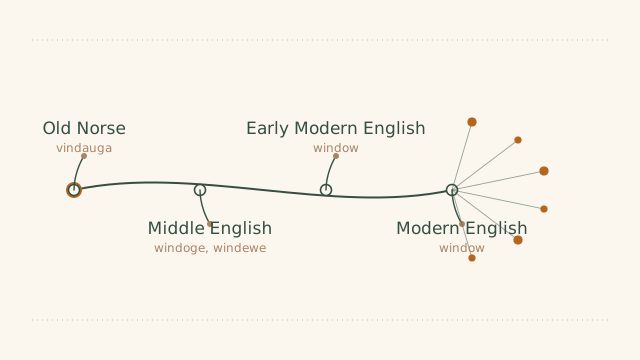
Etymology tree
Open any stage for the note attached to it.
-
01 Old Norse vindauga
wind-eye
A compound of vindr (wind) and auga (eye). The Norse settlers of northern England brought it, and it displaced the Old English word for the same thing, eagþyrl, "eye-hole".
-
02 Middle English windoge, windewe
an opening for air
Spellings varied for centuries; the -d- was often dropped in speech, giving forms like windo and winnow.
-
03 Early Modern English window
a glazed opening in a wall
Glass became affordable in the 1500s, and the word moved from "hole for air" to "glazed panel" without changing shape.
-
04 Modern English window
an interval of time; an area of a screen
The figurative senses are all twentieth-century: a window of opportunity, a launch window, a browser window.
6 words · branching from the last stage
Stage by stage
| # | Stage | Form | What it meant |
|---|---|---|---|
| 1 | Old Norse | vindauga | wind-eye |
| 2 | Middle English | windoge, windewe | an opening for air |
| 3 | Early Modern English | window | a glazed opening in a wall |
| 4 | Modern English | window | an interval of time; an area of a screen |
A loan that displaced a native word
The Norwegian and Danish settlers who occupied northern and eastern England from the ninth century spoke a language close enough to Old English for the two to mix, and in that mixing a number of everyday Norse words simply replaced their English equivalents. Window is one of them, and unusually it replaced a word that was just as descriptive: Old English eagþyrl, "eye-hole".
The Norse compound is vivid in a different way. Vindauga treats the opening as an eye for the wind rather than a hole for the eye — a house with windows has eyes through which the air moves. The metaphor survived the transition to glass, and it survives today in the phrase "the eyes of the house".
From opening to glass
For most of the word's life a window was an unglazed opening closed with a shutter or a wooden board. Glass was expensive and small panes were leaded together; a glazed window in a peasant house was rare before the sixteenth century, and the word only shifted to mean "the glass itself" as glazing became ordinary.
That shift left traces in English idiom. A window that is "open" is now an odd phrase, since a modern window is a sealed unit, and window shopping and a window seat both preserve the idea of looking through rather than letting air in. To "wind" a room in old inventories meant to close its shutters.
- vindauga (Old Norse) — wind-eye
- eagþyrl (Old English, lost) — eye-hole
- windowe (Middle English) — an opening, often with a shutter
- window (1500s onward) — a glazed panel
- window of opportunity — 1930s, from the language of planning and diplomacy
- browser window — 1990s, a framed area of a screen
Windows in time and software
Every figurative sense of the word is modern, and they all follow the same logic: a window is a limited opening through which you see something, and it frames what you see. A launch window is the interval during which a rocket may be launched; a window of opportunity is the interval during which an action is possible; a window in a schedule is free time.
Computing adopted the word in the 1970s for the rectangular areas of a screen, and the metaphor is exact: a window shows a portion of something larger, and several can be open at once. The Windows operating system took its name from this sense in 1985, which means the most common modern use of a Norse wind-eye is a rectangle of pixels.
Kindred family
Cousins of this word across the languages it travelled through.
| Word | Part of speech | Gloss |
|---|---|---|
| wind | noun | moving air, the first element of the compound |
| eye | noun | the second element, from Old Norse auga |
| vindaloo | noun | from Portuguese vinho de alho, wine and garlic — vind- here is wine, not wind |
| auger | noun | a boring tool, from Old English nafu-gar, but respelled by the same "a" confusion that affects auga |
| dormer | noun | a window set in a roof, from Latin dormitorium — a different route to the same object |
| fenestration | noun | the arrangement of windows in a building, from Latin fenestra |